Extreme particle acceleration in X-ray binaries is linked to their jets

Extreme particle acceleration in X-ray binaries is linked to their jets
Laura Olivera-Nieto, Fraser J. Cowie, Sera Markoff, Rob Fender, Justine Crook-Mansour
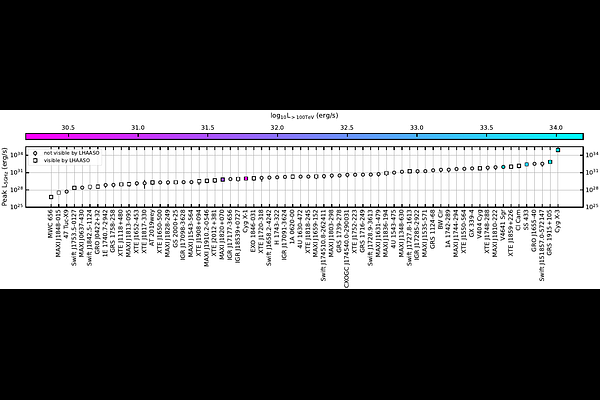
AbstractThe detection of multi-TeV radiation from a handful of black-hole X-ray binaries (BHXRBs) has positioned the source class as promising candidate to explain the cosmic-ray flux in the PeV energy range. To determine what distinguishes the systems detected in the gamma-ray range from the rest of the population, we build on existing catalogues of BHXRBs by including information on the radio and gamma-ray emission from these systems. We then compare the $>100$ TeV gamma-ray luminosity to different properties of the systems and evaluate the strength of the (rank) correlation between them. Additionally, we compare the distribution of BHXRBs with the positions of unassociated gamma-ray sources in the 1LHAASO and 1HGPS catalogues. We find no correlation with the mass of the compact object, the companion mass or the inclination angle. Instead, we find evidence for a strong correlation between the gamma-ray luminosity and the radio and hard-state X-ray luminosities in our sample. The limited number of gamma-ray detections means that this correlation cannot yet be claimed as statistically significant. We find indications that a high (>20\%) duty cycle (defined as fraction of time spent in outburst) might be a requirement for $>100$ TeV gamma-ray loudness. We find significant evidence ($>3σ$) that BHXRBs are located near unassociated gamma-ray sources in the region of the sky not covered by LHAASO. This evidence is only significant when comparing to BHXRBs detected in the radio band. We conclude that radio-bright BHXRBs with a high duty cycle are more likely to be detected as gamma-ray sources than sources which are not detected in the radio band or those with low duty cycles. This result indicates that the particles responsible for the gamma-ray emission are associated with the jets, either accelerated within them or via their interaction with their surroundings.