Apollo-IRE1: A Genetically Encoded Sensor for Live Cell and Multiplexed Imaging of ER Stress

Apollo-IRE1: A Genetically Encoded Sensor for Live Cell and Multiplexed Imaging of ER Stress
Floro, E. J.; Bennett, A. M.; Regeenes, R.; Chang, H. H.; Gulati, N.; Ting, K. K. Y.; Rocheleau, J. V.
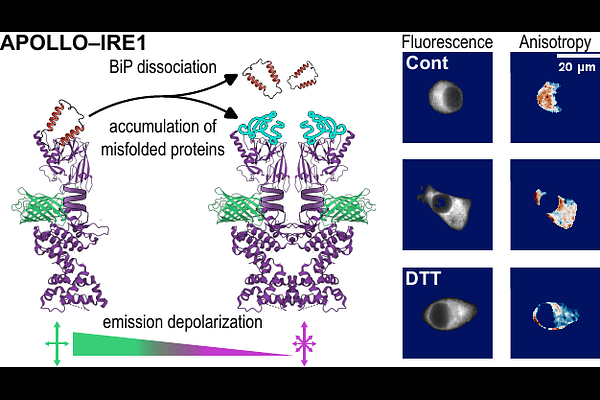
AbstractPancreatic beta cells face exceptional protein folding demands from high insulin production requirements, placing extraordinary stress on the ER and contributing to dysfunction in diabetes pathogenesis. Monitoring ER stress dynamics in living cells remains challenging due to the destructive nature of traditional biochemical methods and the limitations of existing fluorescent sensors. Here, we present Apollo-IRE1, a genetically encoded sensor that reports on stress-induced IRE1 oligomerization and associated change in homoFRET via changes in fluorescence anisotropy. Apollo-IRE1 provides a ratiometric, intensity-independent readout, resulting in low day-to-day variability and a minimal spectral bandwidth, enabling multiplexed imaging alongside other cellular parameters. Photobleaching and enhancement curve analysis show that Apollo-IRE1 exists in apparent monomeric, dimeric, and oligomeric states corresponding to baseline, moderate, and terminal ER stress conditions. The sensor also responds rapidly to chemical and physiological ER stressors in both immortalized beta-cell lines and primary mouse islet cells. These data establish Apollo-IRE1 as a practical tool for investigating ER stress dynamics in beta cells and other contexts where longitudinal single-cell measurements are essential.