Unique mineralization pattern revealed in TBCK syndrome mouse model

Unique mineralization pattern revealed in TBCK syndrome mouse model
Katsura, K. A.; Jiang, Y.; Didziokas, M.; Badt, N. Z.; Dougherty, S.; Vining, K. H.; Bhoj, E. J.
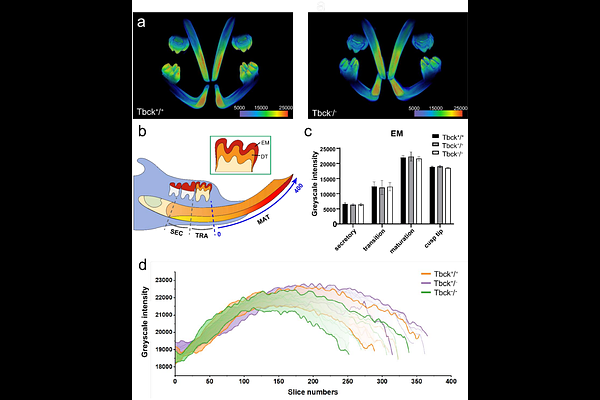
AbstractTBCK syndrome is a severe degenerative leukoencephalopathy with multisystem involvement. Neurodevelopmental, craniofacial, and pulmonary challenges are among the topmost effects on these children. TBCK has been implicated in endo-lysosomal regulation, RNA transport, and mTOR-associated pathways, all of which are critical for the development of mineralized tissue. Although craniofacial abnormalities can be clinically apparent, conventional imaging approaches may overlook subtle defects in mineral quality. Here, we apply our multimodal framework to investigate the mineralization of enamel, dentin, and alveolar bone in a Tbck knockout mouse model. This is the first time our multimodal framework will be applied to a genetic condition. Using micro-computed tomography (microCT), histology, nanoindentation, energy-dispersive spectroscopy, and Raman spectroscopy, we identify tissue- and stage-dependent mineral effects undetected by microCT alone. Tbck loss resulted in differences in enamel and dentin element compositions as early as secretory and transition stages, while mechanical properties remained undetected until maturation stage. Notably, Tbck knockout enamel exhibited reduced calcium and phosphorus content, along with increased carbon content during early mineralization, consistent with the retained organic matrix. Additionally, marked and opposing alterations in magnesium and iron levels began at the secretory stage. Together, these findings define a previously unrecognized mineralization signature associated with TBCK deficiency and establish multimodal hard-tissue analysis as a sensitive approach for detecting early craniofacial phenotypes in rare genetic disorders.