Reassessing planetary composition: Evidence of rock-dominated envelopes in Uranus and Neptune

Reassessing planetary composition: Evidence of rock-dominated envelopes in Uranus and Neptune
Vanesa Ramirez, Yamila Miguel, Saburo Howard
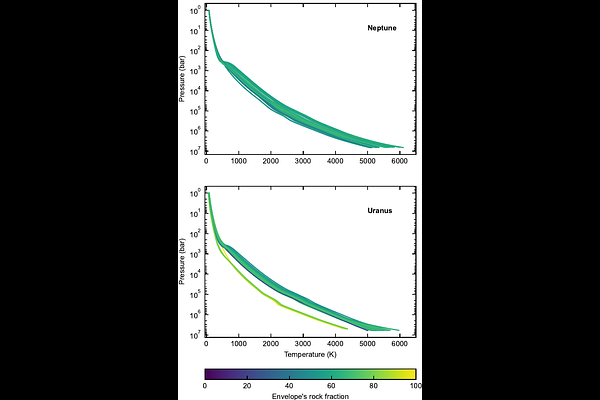
AbstractAlthough Uranus and Neptune are commonly classified as ice giants, their exact compositions remain poorly constrained. Recent studies of outer Solar System bodies challenge the traditional view that these planets are primarily ice-dominated, suggesting that refractory material plays a more significant role. Determining the proportions of ice and rock within Uranus and Neptune is essential for understanding their formation and the evolutionary history of the Solar System. In this work we computed interior structure models for both planets and explored, within a Bayesian framework, the range of compositions that satisfy the available observational constraints. We quantified the resulting ice and rock fractions and analyzed their impact on the inferred internal structure. Our results suggest that the envelopes of both Uranus and Neptune are systematically enriched in refractory material, with median rock fractions of approximately 60% within the heavy-element component, similar to Pluto, Kuiper belt objects, and comets. In contrast, the deep interiors of the two planets exhibit distinct compositions: Neptune is best fit by relatively rock-rich mantles (median rock fraction of ~ 55%), whereas Uranus is inferred to have more ice-rich mantles (median rock fraction of ~ 41%), consistent with a more strongly stratified structure. These results point to compositional differences between Uranus and Neptune that may reflect divergent formation and evolutionary pathways.