Improving Solar Flare Soft X-ray Classification With FOXES: A Framework For Operational X-ray Emission Synthesis

Improving Solar Flare Soft X-ray Classification With FOXES: A Framework For Operational X-ray Emission Synthesis
Griffin T. Goodwin, Alison J. March, Jayant Biradar, Christoph Schirninger, Robert Jarolim, Angelos Vourlidas, Viacheslav M. Sadykov, Lorien Pratt
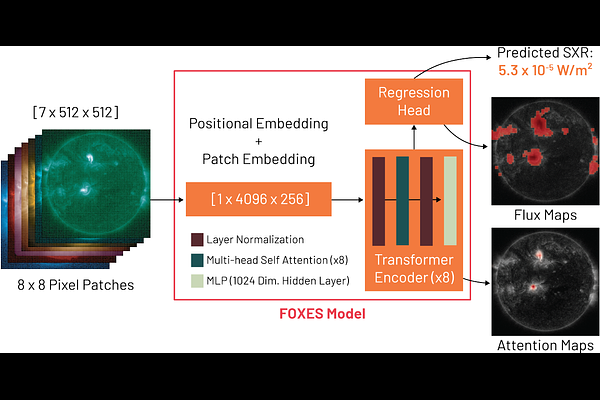
AbstractThe Geostationary Operational Environmental Satellite (GOES) solar soft X-ray (SXR) irradiance in the 1-8Å wavelength range is a long-standing measure of solar activity, used to define the classification of flare strengths. As a result, the flare class, along with the SXR light curves, are routinely used as a primary input for forecasting properties of space weather drivers, from coronal mass ejection speed to energetic particle output. However, the GOES SXR irradiance lacks spatial information, leading to known classification errors, such as misattributed flare locations during periods of high activity. Moreover, GOES only provides observations from Earth's orbit, hindering forecasting for other places in the heliosphere. Motivated by these limitations, we introduce the Framework for Operational X-ray Emission Synthesis (FOXES), a Vision Transformer-based approach for translating Extreme Ultraviolet (EUV) spatially-resolved observations into SXR irradiance predictions. The model produces two outputs: (1) a global 1-8Å SXR flux prediction and (2) per-patch flux contributions, which offer a spatially-resolved interpretation of where the model attributes SXR emission. Trained, validated, and tested on over 3200 hours of observations, FOXES has demonstrated a translational mean absolute error of 0.051 dex for integrated SXR measurements. FOXES has also shown promise in dissecting the solar background SXR flux during flaring and non-flaring events. Overall, this model paves the way for EUV-based spatially-resolved flare detection to be extended beyond Earth's line of sight. Such capabilities could lead to a more comprehensive flare catalog and enable a true multiviewpoint monitoring of solar activity.