Multi-messenger View of White Dwarf Tidal Disruption Events by Intermediate-Mass Black Holes: I. Gravitational Waves and Disk Photon and Neutrino Emissions

Multi-messenger View of White Dwarf Tidal Disruption Events by Intermediate-Mass Black Holes: I. Gravitational Waves and Disk Photon and Neutrino Emissions
Jin-Hong Chen, Lixin Dai, Bing Zhang
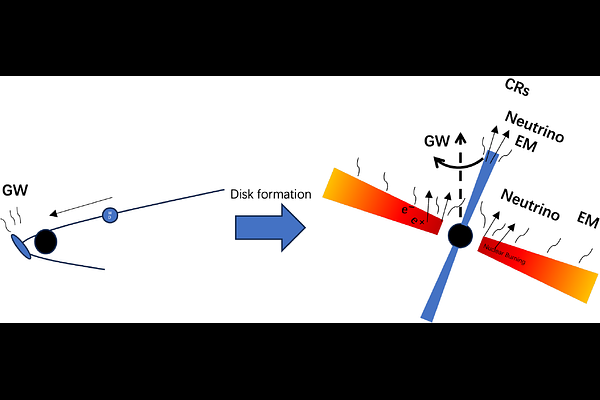
AbstractWhite dwarf (WD) tidal disruption events (TDEs) provide a unique window onto intermediate-mass black holes (IMBHs). We present a multi-messenger view of these systems in two papers. In this paper, we develop an accretion-disk model for WD--TDEs in which the bound debris accretes at extremely super-Eddington rates, $\sim 10^5$--$10^9$ times higher than in typical (main-sequence) TDEs. The model includes magnetic pressure, nuclear-burning heating, wind mass loss, and neutrino production via $e^{\pm}$ pair annihilation. At such high accretion rates, the gas and radiation temperatures of the inner flow can reach $T\gtrsim 10^9\,\mathrm{K}$, enabling prolific pair production and MeV neutrino emission. We find that the disk is predominantly advection dominated over a broad range of accretion rates, while disk winds can partially cool the flow and reduce the inner temperature. The predicted thermal EM emission is nearly insensitive to the fallback rate in the super-Eddington regime: the luminosity only mildly exceeds the IMBH Eddington luminosity and the spectrum peaks at $\sim 0.1$--$1\,\mathrm{keV}$, implying detectability with current X-ray facilities such as Einstein Probe. For low-mass IMBHs ($\sim 10^3\,M_{\odot}$), the disk can also produce a burst of MeV neutrinos with luminosities up to $\sim 10^{47}\,\mathrm{erg\,s^{-1}}$ for ONeMg WD--TDEs, although detectability with current neutrino detectors (e.g., Super-Kamiokande and JUNO) is limited to Galactic distances. Finally, we estimate the GW burst produced during the final passage prior to disruption, which peaks at $\sim 0.1$--$1\,\mathrm{Hz}$, placing WD--TDEs in the target band of proposed decihertz detectors and motivating coordinated GW+EM+neutrino searches. We also present a first exploration of GWs from a precessing WD--TDE disk; this signal is much weaker, with a detection horizon $\lesssim 1\,\mathrm{Mpc}$ for these missions.