Parasite defense covaries with reproductive timing, not with resistance

Parasite defense covaries with reproductive timing, not with resistance
Gibson, A. K.; Peng, L.; Batterton, T.; Channamraju, N.; Feist, V.; Hesse, S.; Janisch, A.; Shui, H.
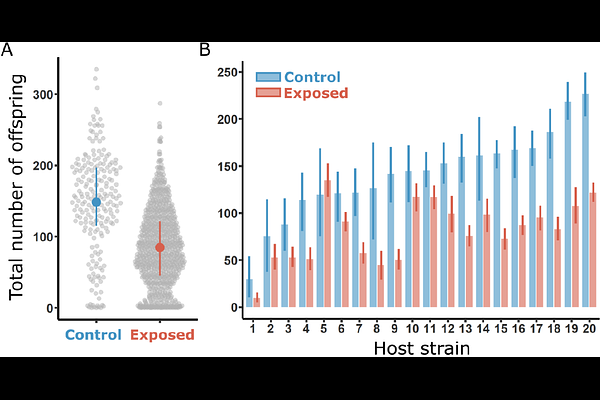
AbstractParasite defense is the ability of a host to minimize fitness loss to parasites, and it is among the most variable phenotypes in natural populations. We expect this variation in defense to facilitate rapid adaptation under parasite-mediated selection. What we do not know is what traits are most likely to evolve in response to this selection. A common assumption is that the most defended hosts are the most resistant, meaning they limit the establishment and growth of infecting parasites. Under this assumption, resistance traits should evolve readily under parasite selection. Resistance is, however, just one of many strategies hosts use to defend against parasites, and it does not consistently covary with parasite defense. We accordingly ask: which host traits covary with parasite defense and are thus likely to respond to parasite selection? We use controlled exposures to characterize genetic variation in defense of the nematode Caenorhabditis elegans against its natural microsporidian parasites. We report extensive variation in parasite defense among wild strains of C. elegans: some strains lost 60% of fecundity under parasite exposure, while others were unaffected. We then tested the covariance of defense with two prominent host traits, resistance and reproductive timing. Our results did not support the hypothesis that resistance covaries with defense: strains with lower parasite burden did not have higher relative fecundity under exposure. Our results instead supported the hypothesis that life history covaries with defense: host strains that reproduced quickly had higher relative fecundity under exposure, consistent with the idea that parasites diminish future reproductive opportunities. Moreover, we detected substantial heritability of fecundity traits but low heritability of resistance traits. Together, these findings indicate significant potential for adaptation of wild C. elegans populations to defend against their natural parasites. They further predict that life history traits will evolve rapidly in response to parasite selection.