Incorporating physical source parameters into microlensing modeling

Incorporating physical source parameters into microlensing modeling
Mateusz J. Mróz, Radosław Poleski, Andrzej Udalski, Jan Skowron, Paweł Pietrukowicz, Michał K. Szymański, Przemek Mróz, Mariusz Gromadzki, Patryk Iwanek, Szymon Kozłowski, Milena Ratajczak, Krzysztof A. Rybicki, Dorota M. Skowron, Igor Soszyński, Krzysztof Ulaczyk, Marcin Wrona, Zofia Buzik
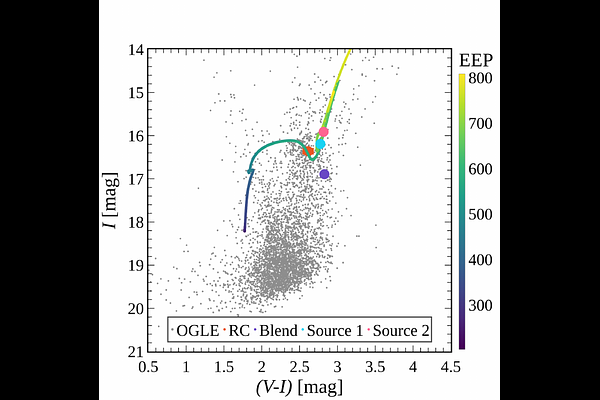
AbstractModeling of complex microlensing events suffers from many difficult-to-disentangle degeneracies. This is especially the case for orbital motion of the source in a binary system, the so-called xallarap effect. To address the degeneracies inherent in xallarap modeling, we developed a novel approach that directly samples the physical parameters of the source stars (initial mass, evolutionary phase, metallicity, distance, and reddening) during MCMC fitting. In our approach the physical parameters of the source are estimated using MIST stellar evolution models. This parametrization imposes astrophysical constraints that help identify the physically most probable solutions. We test our method on the complex microlensing event OGLE-2017-BLG-0114, which exhibits signatures that can be traced to the complexity of the source system. We successfully constrained the microlensing models, achieving improvements in the Einstein ring radius estimates by up to an order of magnitude in the case of binary source models.