Transient narrowband radio bursts from 1E 1547.0-5408

Transient narrowband radio bursts from 1E 1547.0-5408
Marcus E. Lower, Paul Scholz, Fernando Camilo, David M. Palmer, John E. Reynolds, John M. Sarkissian, Lawrence J. Toomey, George Younes
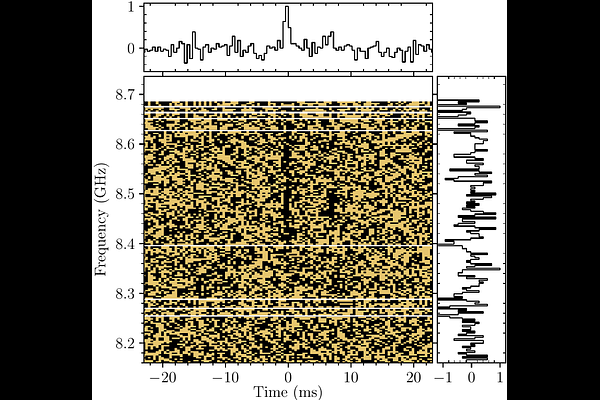
AbstractRadio-loud magnetars are well known for exhibiting rare and unusual radiative properties that are seldom seen in the wider pulsar population. Yet one form of emissive behavior that remains elusive among pulsars and magnetars is narrowband bursts of radio waves. Such emission is a hallmark of repeating sources of fast radio bursts (FRBs), intense radio flashes that originate from distant galaxies. Here, we report the detection of 84 narrowband radio bursts during observations of the magnetar 1E 1547.0-5408 by the Murriyang telescope one month after its 2009 outburst. All but six bursts appear temporally unresolved at millisecond timescales. They were confined to a transient profile component that appeared between 2009 February 23 to 25. This coincided with both dramatic changes in the magnetar line-of-sight magnetic-field geometry, and an emergent pulsed hard X-ray component detected by the Rossi X-ray Timing Explorer. The leading edge of the hard X-ray emission was phase-aligned with the narrowband component, indicating the bursts likely originated from pair cascades along closed magnetic field lines. Such closed-field emission could contribute to the lack of second-scale periodicity in repeating FRBs. Our characterization of the bursts suggests they may represent a low-energy analogue of the repeating FRB mechanism, further linking FRB progenitors to young, highly magnetized neutron stars.