Distinct First-to-Second Peak Yield Ratios and Timescales Reveal a Sub-dominant Prompt Channel

Distinct First-to-Second Peak Yield Ratios and Timescales Reveal a Sub-dominant Prompt Channel
Yossef Zenati, Paz Beniamini, Kenta Hotokezaka
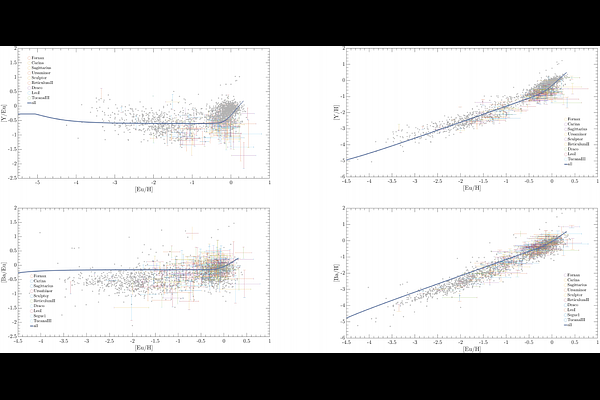
AbstractStellar abundances reveal non-monotonic [Y/Eu] and [Sr/Eu] evolution, a systematic decline with increasing [Eu/H] at low metallicity, a minimum at $[\rm{Eu/H}] \sim -0.3$ and then a rise at high metallicity. This behavior requires at least three distinct neutron-capture sources operating on different timescales. We develop a one-zone chemical-evolution model constraining their typical delay-times, rates, and yield ratios. Reproducing the observed $\rm{[Y/Eu]}$ and $\rm{[Sr/Eu]}$ sequences requires, a delayed $r$-process channel (most likely binary neutron-star mergers) dominating Eu production ($\gtrsim 95\%$ of total Eu). A prompt channel preferentially producing first-peak elements with minimal Eu, explaining the increasing [Y/Eu] at decreasing [Eu/H] below $[\rm{Eu/H}] \lesssim -2.5$; and delayed AGB $s$-process enrichment with delays greater than $t_{min} = 0.3-0.6$\,Gyr reproducing the late-time upturn in Y (Sr). Our model quantitatively reproduces all constraints, including the large $Δ[\rm{Y/Eu}] \approx 0.6$ dex variation between the late-time rise [Eu/H] and the minimum value, the location of the minimum at [Eu/H] $\sim -0.3$ and late-time rise. The first-to-second peak yield ratios correspond to $[\rm{Y/Eu}] \approx -0.3$ (prompt) and $\approx -0.8$ (BNS mergers). The observed $Δ[\rm{Y/Eu}]$ amplitude establishes a model-independent lower limit on the first to second peak yield ratio $\gtrsim 3.4$ between the prompt and delayed channels, ruling out models with similar prompt and delayed yield ratios. These results demonstrate that explaining the observed heavy-element abundance patterns requires multiple channels with distinct nucleosynthetic signatures and operational timescales, providing constraints on the relative rates, delay times, and yield patterns of candidate production sites.