\texttt{TransFit-MAG}: Self-Consistent Modeling of Magnetar-Powered Transients from Shock Breakout to Spin-Down Heating

\texttt{TransFit-MAG}: Self-Consistent Modeling of Magnetar-Powered Transients from Shock Breakout to Spin-Down Heating
Jing-Yao Li, Liang-Duan Liu, Yun-Wei Yu, Guang-Lei Wu, Yu-Hao Zhang
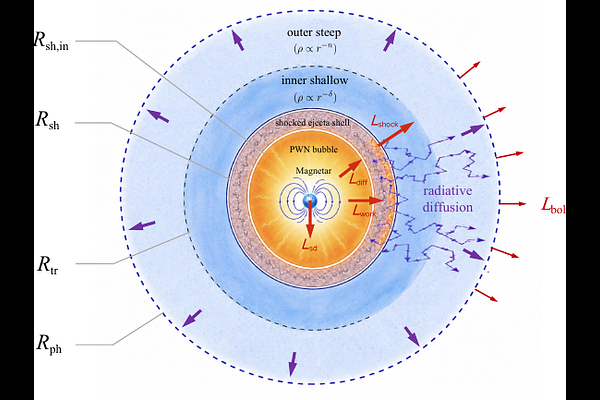
AbstractMagnetar engines are widely invoked to power luminous optical transients, but their early emission depends on the coupled evolution of engine injection, shock heating, adiabatic cooling, and radiative diffusion. We present \texttt{TransFit-MAG}, a time-dependent radiative-diffusion framework for magnetar-powered transients. The model couples the \texttt{TransFit} diffusion solver to the dynamics of a magnetar-inflated pulsar wind nebula (PWN) and its forward shock propagating through homologously expanding ejecta, calculating the internal radiation-energy distribution, photospheric evolution, shock-heating location, and emergent luminosity self-consistently. For different parameter values, the model naturally produces well-separated double peaks, partially merged peaks, or single broad peaks. These results suggest that early bumps and broad single peaks in engine-powered transients may be understood within a unified engine--shock--diffusion framework, in which the observed diversity reflects the coupled evolution of central-engine power, shock propagation, and radiative transport through expanding ejecta. As an illustrative application, we fit the multiband optical light curves of the double-peaked SLSN-I LSQ14bdq.