The gac system integrates physical and chemical cues to promote plant root attachment

The gac system integrates physical and chemical cues to promote plant root attachment
Sobol, G.; Hershey, D. M.
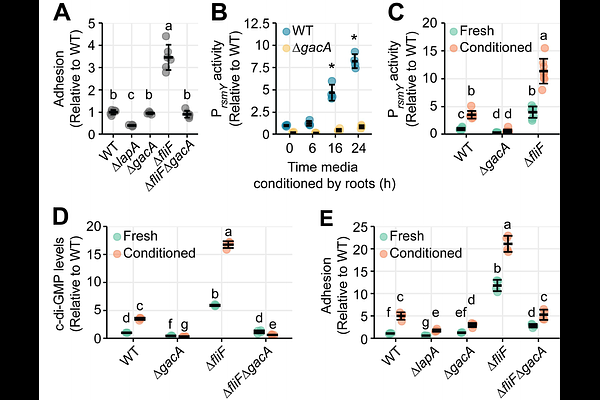
AbstractPlants host complex communities of microbes that are attached to root surfaces. While many studies have sampled mutant populations after prolonged incubation on roots to identify bacterial genes that enable long-term colonization, the molecular mechanisms governing the early stages root attachment remain less understood. Here, we developed an in vitro root culture system that enables controlled and scalable investigation of bacterial attachment to root tissue. We used this platform to perform a genome-wide screen for root attachment determinants in the plant-associated bacterium Pseudomonas protegens Pf-5. Our results reveal that the gacSA two-component system functions as a sensory integration hub for coordinating early root attachment. Mutations that disrupt gacS or gacA cause severe root attachment defects despite having no effect on abiotic surface attachment in standard biofilm assays. Mutation of flagellar assembly genes enhances root attachment by mimicking surface contact and activating the gac system. In parallel, chemical cues released by roots stimulate surface attachment in a gac dependent manner. By integrating these signals, the gac system activates cyclic di-GMP-mediated attachment programs that drive the transition from planktonic to sessile behavior required for root association. We build on this model to show that manipulating flagellar surface sensing enhances the competitive fitness of Pf-5 in the presence of a synthetic bacterial community, suggesting a strategy to improve the competitive fitness of beneficial microbes on crops. These findings establish a mechanistic framework linking surface sensing, global regulation, and root attachment in a beneficial rhizobacterium.