First Metagenome-Assembled Genomes from the Historic Morrow Plots Reveal Management-Associated Dominance of Archaeal Ammonia Oxidizers

First Metagenome-Assembled Genomes from the Historic Morrow Plots Reveal Management-Associated Dominance of Archaeal Ammonia Oxidizers
Nguyen, V. D.; Gao, C.; Gardner, C.; Wang, Z.; Margenot, A. J.; Huang, L.; Ahn, T.-H.
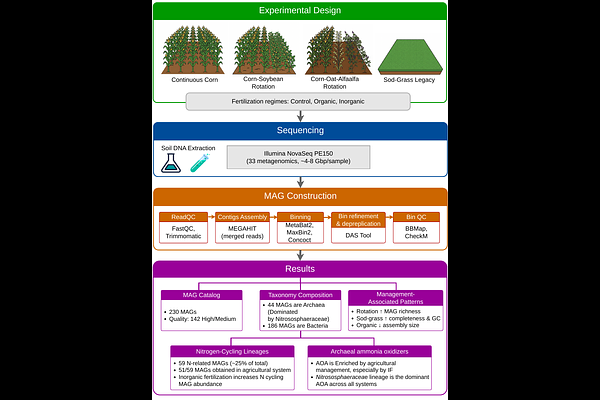
AbstractSoil microbial communities underpin both soil health and agricultural productivity, yet genome-resolved resources from long-term field experiments remain limited. Here, we present a genome-resolved metagenomic dataset from the historic Morrow Plots long-term experiment in central USA, comprising 33 shotgun metagenomes collected across diverse crop rotation and fertilization treatments in year 149 of the experiment. Using a co-assembly, multi-binner workflow, we recovered 230 metagenome-assembled genomes (MAGs), including 44 archaeal and 186 bacterial genomes spanning multiple soil-associated phyla. Among these, 59 MAGs were linked to nitrogen-cycling functions, including ammonia- and nitrite-oxidizing lineages. The dataset also includes genome quality metrics, taxonomic classification, and treatment-resolved abundance patterns across different management regimes. Importantly, these nitrogen guild MAGs enable comparative analyses of nitrifier ecology, genome diversity, and functional variation linked to management in agricultural soils. Together, these resources establish a unique benchmark for studying how agricultural practices shape soil microbial communities at genome level, with associated long-term crop yield and soil fertility changes since the experiment's inception in 1876.