Ghostbusting the national bird checklist: integrative evidence shows that Pionus fuscus does not occur in Colombia

Ghostbusting the national bird checklist: integrative evidence shows that Pionus fuscus does not occur in Colombia
Carrillo-Restrepo, J. C.; Velasquez-Tibata, J.
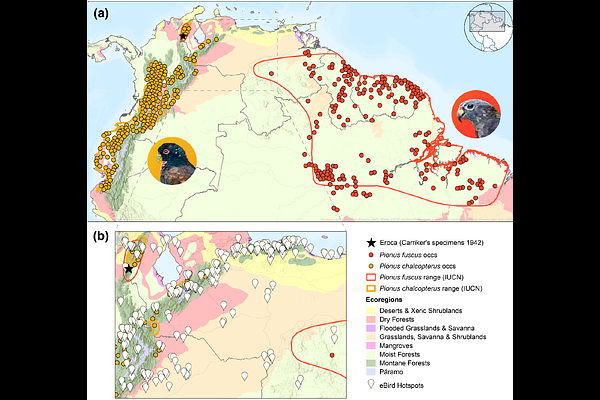
AbstractNatural history collections underpin our understanding of species distributions, yet some historical records remain embedded in modern avifaunal checklists despite limited documentation and no independent verification. One such case concerns to the presence of the Dusky Parrot (Pionus fuscus) in Colombia: although reported from specimens collected by Melbourne A. Carriker Jr. in 1942 in the Serrania de Perija, the species has not been observed in the country for nearly eight decades yet continues to be included in national checklists and conservation assessments. We reassessed the validity of this record by applying a multi-evidence framework integrating historic archival reconstruction, specimen-based morphological comparisons, climatic niche analyses, biogeographic limit assessment and contemporary survey-effort data. Historical documentation and morphological evidence based on high-resolution specimen images and associated curatorial records demonstrate that the Carriker Jr. specimens correspond to P. chalcopterus, not P. fuscus. Climatic niche analyses reveal minimal environmental overlap between P. chalcopterus and P. fuscus, and place the Perija locality within the climatic niche of P. chalcopterus, while regional biogeography and extensive modern birdwatching coverage provide no support for the occurrence of P. fuscus in Perija. Together, these concordant lines of evidence demonstrate that P. fuscus does not occur in Colombia. Our findings support its removal from national bird lists and conservation assessments and highlight how integrated, multi-evidence reassessments of historical records strengthen ornithological baselines, improve biogeographic inference and ensure that conservation priorities rest on verifiable evidence.