Structural dynamics between Argonaute-2 and CK1α promote target RNA release in microRNA-mediated silencing

Structural dynamics between Argonaute-2 and CK1α promote target RNA release in microRNA-mediated silencing
Garg, A.; Braviner, L.; Axhemi, A.; Bibel, B.; Joshua-Tor, L.
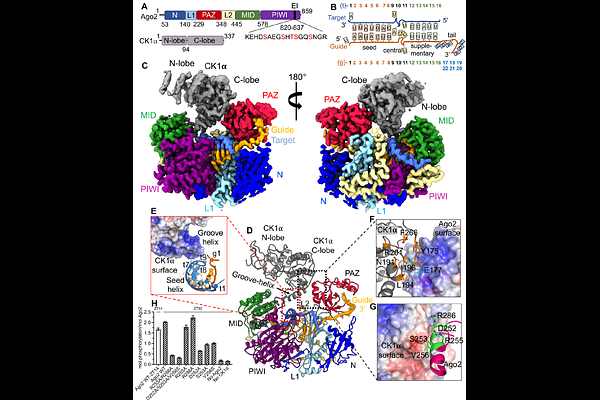
AbstractArgonaute (Ago) proteins associate with 20-22 nucleotide (nt) long microRNAs (miRNAs) to constitute the functional RISC core and downregulate mRNAs containing complementarity to the seed sequence1-3. Target RNA engagement in RISC stimulates CK1-mediated phosphorylation of the conserved eukaryotic insertion (EI) in Ago, releasing the target and enabling the RISC complex to suppress additional target sites for efficient miRNA-mediated silencing4-6. Here, we provide a complete structural view of miRNA guide and target binding to human Ago2, showing Ago2 holding the double-stranded guide-target RNA in an untwisted conformation at its center. We visualize the dynamic changes that RISC undergoes as the guide supplementary region progressively base pairs with the target, enabling CK1 binding. Following seed-helix assembly, initial supplementary pairing restricts RISC to a closed form, while with half-supplementary pairing, the PAZ domain moves to open RISC to become receptive to CK1, exhibiting an initial increase in Ago2 phosphorylation. Complete supplementary pairing supports a full PAZ-CK1 interface, allowing for hierarchical phosphorylation of the EI. The combination of target repulsion by EI phosphorylation with an unwound guide-target enables efficient RISC turnover.