Thalamocortical constraints on areal connectivity in the developing human brain

Thalamocortical constraints on areal connectivity in the developing human brain
Oldham, S.; Yang, J. Y.; Lautarescu, A.; Bonthrone, A.; Cruddas, J.; Tournier, J.-D.; Batalle, D.; Ball, G.
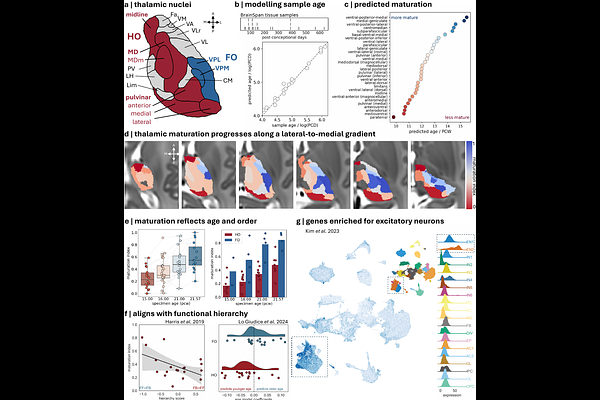
AbstractThe thalamus plays a central role in cortical development, organisation and function. Thalamic nuclei acquire distinct molecular identities during gestation, with first-order relays maturing before higher-order nuclei. Thalamic afferents innervate the cortical plate with a precise order, disruptions to which alter cortical function. Recent models propose that thalamic input to primary sensory cortex constrains the development of wider cortical networks, promoting the formation of highly-connected hubs in association cortex. Here, we combine neuroimaging, post mortem gene expression data and network modelling to examine how the timing and spatial distribution of thalamocortical innervation influences the formation of cortical networks during gestation. We find that the maturation rates of thalamic nuclei align with predicted timing and distribution of afferent outgrowth. While higher order nuclei connect widely across the cortex, they do not preferentially target high-degree hubs. Instead, hubs emerge from interdependent spatiotemporal constraints imposed by both wiring distance and thalamocortical maturation.