Entanglement generation in a two-body Schrödinger--Newton model

Entanglement generation in a two-body Schrödinger--Newton model
Marcin Płodzień, Julia Osęka-Lenart, Maciej Lewenstein, Michał Eckstein
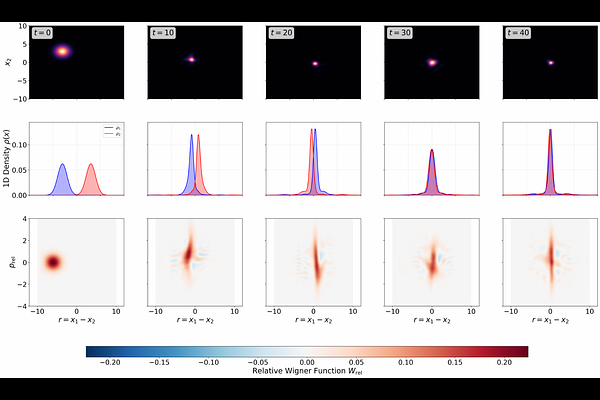
AbstractThe Schrödinger--Newton (SN) equation provides a semiclassical framework for the evolution of self-gravitating of massive quantum systems. We propose a two-body Schrödinger--Newton model that separates local nonlinear self-localization from the nonseparable Newtonian pair potential. Analytically, we show that the nonlinear self-field preserves the Schmidt spectrum, whereas direct entanglement generation arises from the nonseparable pair potential. Using numerical simulations in a regularized one-dimensional geometry, we find that entanglement generation depends sensitively on the initial spatial configuration and on the mass ratio. Highly localized, self-bound wavepackets experience minimal entanglement growth during scattering. Spatial delocalization and kinetic dispersion broaden the interaction region, amplifying the entangling power of the pair potential and exciting higher-order spatial modes. For dispersive Gaussian initial states, mass asymmetry shatters the lighter particle, producing Wigner negativity and rapid entanglement growth, whereas stationary SN profiles strongly suppress this effect. Stationary SN profiles isolate the bare pair-potential contribution; dispersive Gaussian initial states inflate it.