Structural Complementarity Maximizes Feasibility and Stability in Microbial Community Coalescence

Structural Complementarity Maximizes Feasibility and Stability in Microbial Community Coalescence
Zhu, Y.; Waring, B. G.; Ransome, E.; Graystock, P.; Dignam, B. E. A.; Paruit, L.; van Schalkwyk, H. J.; Deng, J.; Bell, T.; Pawar, S.
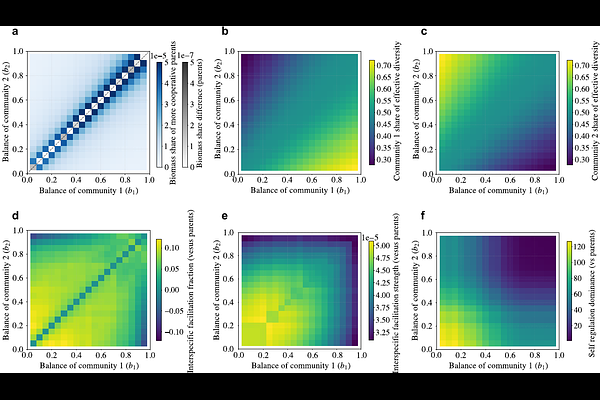
AbstractMicrobial communities frequently coalesce through dispersal, disturbance, or deliberate transplantation, yet the dynamical consequences of such coalescence remain poorly understood. Here, we show that coalescence can function as a structural design mechanism to enhance microbial community robustness. Using a mechanistic consumer-resource model in which the balance between competition and metabolic cooperation is explicitly tunable, we quantify how interaction structure shapes both feasibility, namely the environmental domain supporting coexistence, and dynamical stability. Cooperation-dominated communities exhibit greater but more variable feasibility and intrinsic stability than competition-dominated communities. Strikingly, coalescing communities with maximally distinct interaction structures consistently maximizes both feasibility and stability by reducing alignment among interaction vectors and strengthening effective self-regulation in the resulting assemblage. Heterogeneous coalescence balances reduced facilitation, moderated interspecific effects, and stronger self-regulation. These results identify structural complementarity as a general principle for assembling robust microbial ecosystems and provide a theoretical foundation for microbiome engineering strategies that enhance persistence and functional stability.