Reproductive morph specialisation facilitated by a maternal sex-determining region in a fungus gnat (Bradysia coprophila)

Reproductive morph specialisation facilitated by a maternal sex-determining region in a fungus gnat (Bradysia coprophila)
Henot, M.; Baird, R. B.; Duncan, F.; Lee, J. S. Y.; Ross, L.
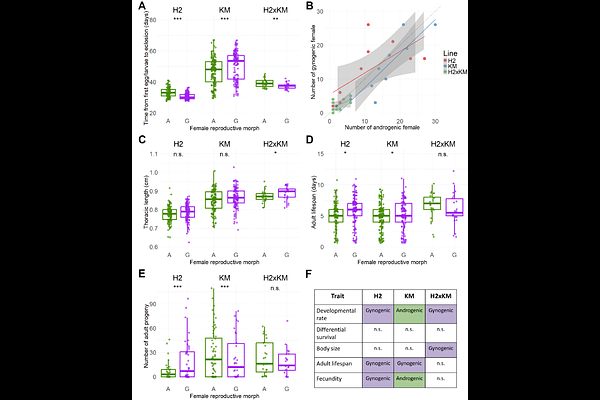
AbstractSexual reproduction is a ubiquitous process in eukaryotes, yet mechanisms of sex determination are strikingly diverse. One unique and understudied system is maternal genetic sex determination (mat-GSD), in which the genotype of the mother determines offspring sex. In some species, mothers further specialise into genetically determined reproductive morphs: gynogenic females that produce all-female broods, and androgenic females that produce all-male broods. Although this partition echoes the evolution of separate, dimorphic sexes, it remains unclear whether the morphs diverge in traits beyond offspring sex determination, and how this affects the evolutionary dynamics of the mating system. Here we address these questions in the dark-winged fungus gnat Bradysia coprophila, in which female morphs are determined by a large X-linked inversion. We show that maternal reproductive morphs diverge significantly in life history traits and gene expression profile, suggesting adaptive specialisation into their reproductive roles. We further evaluate potential drivers for specialisation and test two of them empirically, showing evidence in line with sex-specific maternal provisioning. By drawing explicit parallels with sex chromosome evolution and sexual dimorphism, our results extend core principles of reproductive specialisation to mat-GSD systems, and underscore the potential of unusual reproductive systems for extending fundamental evolutionary theory on how selection and genomic architecture interact to shape mating system evolution.