Seabird calls are shaped by prosody, efficiency, and rhythmic encoding

Seabird calls are shaped by prosody, efficiency, and rhythmic encoding
Osiecka, A. N.; Wojczulanis-Jakubas, K.; Burchardt, L. S.
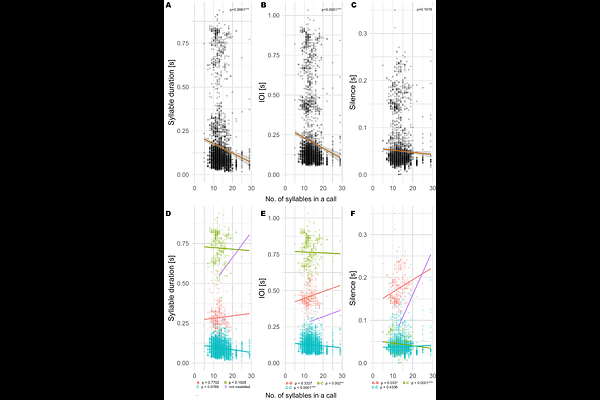
AbstractIn the search for universals shaping acoustic communication across species, we increasingly look for patterns known from human languages and music in non-human animals. These parallels are often explored separately and with limited ecological context. Here, we take a deep dive into the temporal structure of a complex call used by the little auk (Alle alle), a pelagic seabird with elaborate vocal behaviour and socially complex colonial life. Based on syllable durations, intervals and silences, we examine its conformance to linguistic laws, rhythmic structure and information content. This reveals intricate problems of temporal organisation: while the calls conform not only to linguistic laws of brevity but also to the initial and final lengthening known from human prosody, these effects interact with the internal structure of the call and information carried within it. To our knowledge, this is the first time that conformance to multiple linguistic laws, exceeding simple vocal efficiency, has been described for a non-human, non-vocal learning animal. The calls' rhythmic structure shows a progressive rallentando - a systematic slowing driven by changes in syllable and silence durations and the intervals between syllable onsets. The exact patterns of this rallentando are indicative of the caller's sex and individually specific. These results reveal how seabird communication is shaped not only by efficiency universals, but also the specific pressures of colonial life. Our work highlights the temporal structure as an important axis of communication evolution, but also serves as a reminder to consider the species' ecological reality and the function, not only presence, of temporal organisation.