Distinct Disinhibitory Circuits Link Short-Term Adaptation to Familiarity and Reward Learning in Visual Cortex

Distinct Disinhibitory Circuits Link Short-Term Adaptation to Familiarity and Reward Learning in Visual Cortex
Hinojosa, A. J.; Dominiak, S. E.; Kosiachkin, Y.; Lagnado, L.
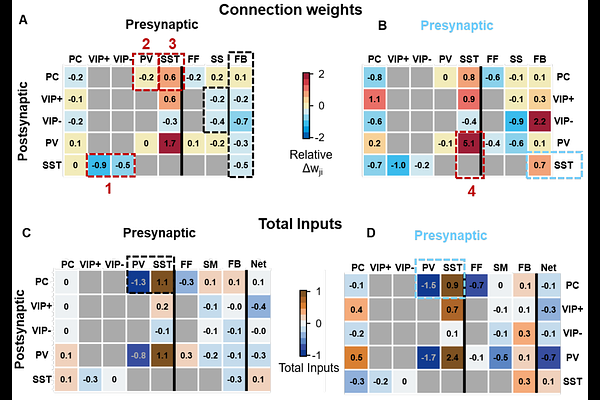
AbstractSensory cortices filter repeated inputs through rapid adaptation over seconds and experience-driven learning over days. Although these forms of plasticity occur simultaneously, it is not known how they interact within cortical circuits. We combined two-photon calcium imaging, data-driven circuit modelling and optogenetics to investigate how short-term adaptation in layer 2/3 of mouse V1 is shaped by stimulus familiarity and reward association. Habituation reduced the fraction of pyramidal cells responsive to a visual stimulus, whereas reward association maintained overall responsivity. In contrast, both forms of learning shifted pyramidal cell adaptation from depression toward sensitization, but through distinct circuit mechanisms. Habituation reduced disinhibition through the VIP[->]SST[->]PC pathway by weakening feedback activation of VIPs and VIP[->]SST connections. Reward association counteracted this effect by increasing disinhibition through the SST[->]PV[->]PC pathway, strengthening SST[->]PV connections while reducing SST[->]PC inputs. Despite engaging distinct disinhibitory circuits and producing divergent effects on pyramidal cell responsivity, both forms of learning converged on a reduced PV:SST input ratio to pyramidal cells, thereby biasing V1 toward sensitizing adaptation. These results identify changes in cortical circuits that link the plasticity of fast adaptation to simple forms of learning.