Enhanced Mycelium of Thought (EMoT): A Bio-Inspired Hierarchical Reasoning Architecture with Strategic Dormancy and Mnemonic Encoding

Enhanced Mycelium of Thought (EMoT): A Bio-Inspired Hierarchical Reasoning Architecture with Strategic Dormancy and Mnemonic Encoding
Florian Odi Stummer
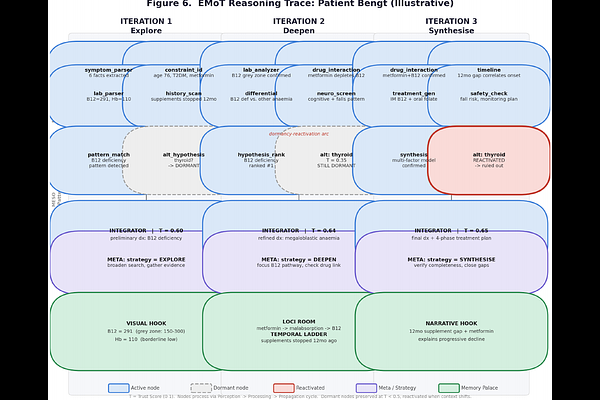
AbstractCurrent prompting paradigms for large language models (LLMs), including Chain-of-Thought (CoT) and Tree-of-Thoughts (ToT), follow linear or tree-structured reasoning paths that lack persistent memory, strategic dormancy, and cross-domain synthesis. We present the Enhanced Mycelium of Thought (EMoT) framework, a bio-inspired reasoning architecture that organises cognitive processing into a four-level hierarchy (Micro, Meso, Macro, Meta), implements strategic dormancy and reactivation of reasoning nodes, and integrates a Memory Palace with five mnemonic encoding styles. EMoT is a research prototype for complex, multi-domain problems, not a general-purpose prompting enhancement. Two complementary evaluations reveal a characteristic trade-off. In a blind LLM-as-Judge evaluation across three domains, EMoT achieved near-parity with CoT (4.20 vs. 4.33/5.0) with higher stability, and outperformed CoT on Cross-Domain Synthesis (4.8 vs. 4.4). Ablation studies show that strategic dormancy is architecturally essential (quality collapsed from 4.2 to 1.0 when disabled). On a 15-item short-answer benchmark, EMoT (27%) substantially underperformed simpler baselines, confirming systematic overthinking on simple problems. These results are subject to important limitations: small sample sizes (n=3 complex cases, n=15 short-answer items), LLM-as-Judge evaluation with potential self-preference bias, and approximately 33-fold computational cost overhead. To our knowledge, EMoT is the first reasoning framework to combine hierarchical topology, strategic thought dormancy with reactivation, and mnemonic memory encoding in a single architecture.