Stellar Variability and Distance Indicators in the Near-infrared in Nearby Galaxies. II. Pulsating Stars in the Carina Dwarf Spheroidal

Stellar Variability and Distance Indicators in the Near-infrared in Nearby Galaxies. II. Pulsating Stars in the Carina Dwarf Spheroidal
Chow-Choong Ngeow, Anupam Bhardwaj, Prashant Nishad, Das Susmita
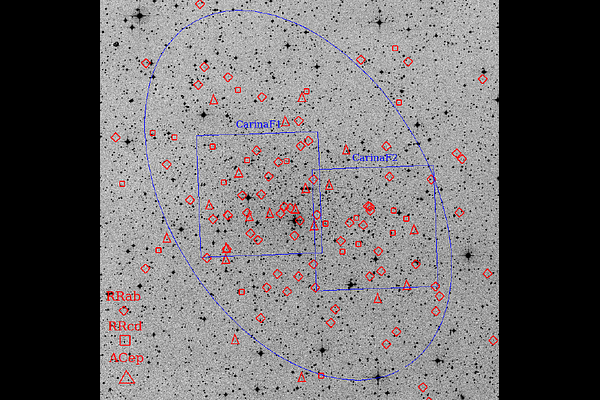
AbstractWe present homogeneous, near-infrared ($JHK_s$ bands) time-series observations of the classical Carina dwarf Spheroidal (dSph) galaxy to determine accurate and precise distances using the pulsating stars as standard candles. These observations cover two Carina dSph fields ($\sim10.8'\times10.8'$) obtained with the FourStar infrared camera mounted on the 6.5-m Magellan Telescope. We collected precise photometric measurements of 43 RR Lyrae, 11 anomalous Cepheids (ACep), and 102 dwarf Cepheids (DCep) in Carina dSph. Using RR Lyrae, we obtained a distance modulus of $20.079\pm0.028\mathrm{(statistical)}\pm0.045\mathrm{(systematic)}$~mag, or a distance to Carina of $103.7\pm1.3\mathrm{(statistical)}\pm2.2\mathrm{(systematic)}$~kpc. The literature calibrations based on SX Phoenicis or delta-Scuti stars were used to anchor the $JHK_s$ period-luminosity relations for DCep. This resulted in a distance modulus that is in excellent agreement with RR Lyrae based determination. Finally, the distance moduli estimates using the ACep were found to be systematically smaller than the RR Lyrae-based distance modulus, suggesting a metallicity dependence on the ACep period-luminosity relation.