Presence of solar inner F-corona and coronal heating

Presence of solar inner F-corona and coronal heating
Z. Q. Qu, R. Y. Zhou, H. Su, Y. Liang
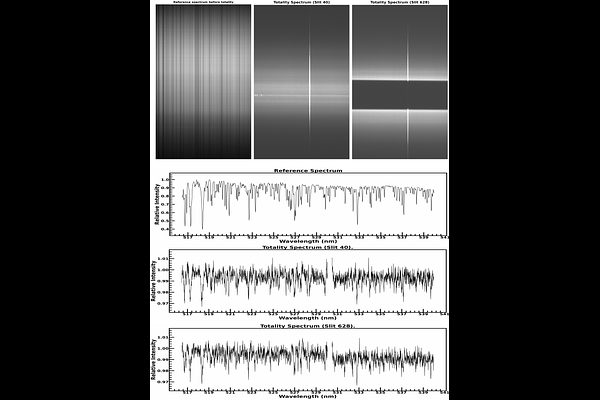
AbstractA new source in solar corona scattering photospheric and chromospheric Fraunhofer spectral lines is detected below a height of one solar radius above solar limb, consisting of tenuous and cool neutral atoms and much fewer once ionized ions. It is demonstrated via maps at the sample Fraunhofer lines within the band from 516.38 to 539.89nm, reconstructed from one set of spatially successive raster scanning data. The dataset was obtained from a spectrograph during the total solar eclipse on April 8, 2024, at Oden, Arkansas, USA. It is revealed from these maps that both the scattering and its spatial distribution depend on spectral lines, yielded from different ionization and excitation states of neutral metal atoms and ions. The distributions show asymmetry and feature of diffusion originated from the photosphere and chromosphere. Ratio of the Fraunhofer line depth to the continuum intensity evaluated over the observational band peaks at 0.25$\%$ and has an average of 0.32$\%$. More discrete and weaker diffusion of emission counterparts of some Fraunhofer lines are detected simultaneously. These properties are critically different from those owned by that F-corona yielded via dust grain scattering beyond heights of about two and half solar radii. Hence a term 'inner F-corona' is dubbed for the assembly of scattering by this new particle source. It becomes definite now that the solar corona consists of not only free electrons and ions but also much fewer yet non-negligible neutral atoms. It is emphasized that global distributions of the outward neutral atom fluxes and coronal magnetic loops can make the abnormal Cowling resistance the most primary mechanism responsible for the coronal heating, via collisions of the neutral atoms injected with ions in the coronal loops. This likes the heating process in Tokamak with neutral beam injection(NBI).