Recurring daytime and nighttime modes of VOC emissions in a cool-temperate oak forest

Recurring daytime and nighttime modes of VOC emissions in a cool-temperate oak forest
Sekimoto, K.; Suyama, Y.; Kita, Y.; Fukuyama, D.; Koss, A.; Matsukami, A.; Tomihira, S.; Yamagishi, H.; Shiojiri, K.; Saito, T.; Yazaki, K.
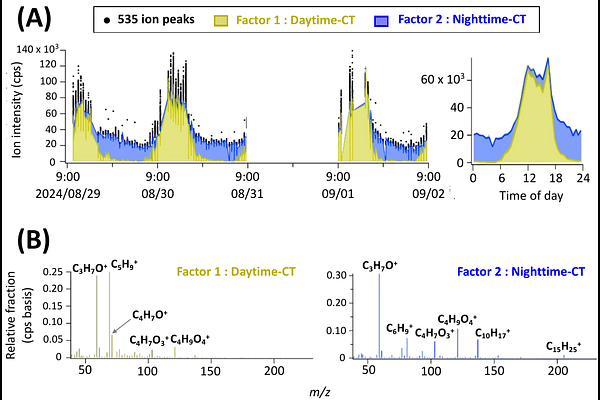
AbstractPlants emit substantial amounts of biogenic volatile organic compounds (VOCs) that link plant physiological activity to ecological interactions and atmospheric chemistry. However, the processes regulating VOC emissions within the forest air and at the interface directly above the canopy remain poorly characterized. In this study, we investigated forest-scale VOC dynamics in a cool-temperate deciduous forest dominated by Quercus crispula using high-time- and high-mass-resolution proton-transfer-reaction time-of-flight mass spectrometry (PTR-ToF-MS) integrated with positive matrix factorization (PMF). This non-targeted, process-oriented framework was applied to forest-interior and canopy-top atmospheres during rain-free summer days in 2024 and 2025 to extract dominant modes of VOC emissions. The PMF consistently resolved two recurring modes characterized by the daytime and nighttime enhancement patterns. The daytime mode was dominated by isoprene and its oxidation products and demonstrated strong and temperature dependence, whereas the nighttime mode was enriched in mono- and sesquiterpenes. The daytime contribution exhibited a pronounced morning-afternoon asymmetry, indicating non-linear physiological and canopy-scale controls. These patterns were reproducible across the years. This study demonstrates that combining PTR-ToF-MS with PMF enables robust, top-down identification of recurring modes of forest VOC variability within and above forest canopies, linking leaf-level physiology and ecosystem-scale atmospheric exchange.