BEACON: JWST NIRCam Pure-parallel Imaging Survey. III. Constraints on the UV LF and the Clustering of z~7-14 Galaxies

BEACON: JWST NIRCam Pure-parallel Imaging Survey. III. Constraints on the UV LF and the Clustering of z~7-14 Galaxies
Kimi C. Kreilgaard, Charlotte A. Mason, Takahiro Morishita, Yechi Zhang, Viola Gelli, Nicha Leethochawalit, Tommaso Treu, Michele Trenti, Abdurro'uf, Hakim Atek, Maruša Bradač, Larry D. Bradley, Andrew J. Bunker, Novan Saputra Haryana, Matthew J. Hayes, Zhaoran Liu, Vihang Mehta, Marc Rafelski, Guido Roberts-Borsani, Claudia Scarlata, Massimo Stiavelli, Ryo A. Sutanto, Kosuke Takahashi, Benedetta Vulcani
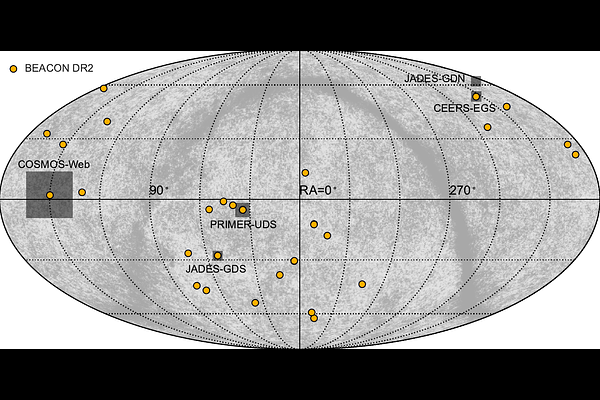
AbstractThe James Webb Space Telescope (JWST) has extended the frontier of galaxy detection to redshifts z>11, finding a high abundance of UV-bright sources that challenge theoretical models. However, most current results come from just a few fields, introducing uncertainties due to cosmic variance. Here, we constrain z~7-14 UV luminosity functions (LFs) over ~400 arcmin^2 across 36 independent sightlines from DR2 of BEACON, a JWST pure-parallel NIRCam multi-band imaging survey. We identify 164 7<z<12 galaxy candidates: 150 F090W-, 14 F115W-, and no robust F150W-dropouts. Based on 11 pointings overlapping with public JWST spectroscopy, we observe 100% purity. Our z~7.5 UV LF agrees with previous bright-end measurements but yields lower number densities at $-21\leq M_\mathrm{UV}\leq-19$. At z~10, our measurements are lower than most photometric JWST results but match spectroscopic constraints, consistent with the high purity of our selection. The LFs at z~7.5 and z~10 are consistent with pre-JWST models, while our limits at z>13 do not rule out a possible excess. We measure significant clustering of bright ($M_\mathrm{UV}<-20.5$) galaxies at 7<z<10. Fields hosting such sources are approximately three times more likely to be overdense relative to the full survey, implying that UV-bright galaxies preferentially reside in the most massive halos at these redshifts. Comparing with semi-numerical simulations, we estimate that $M_{\mathrm{UV}} < -20.5$ galaxies inhabit halos ~0.9 dex less massive at z~11 than at z~7, consistent with a shift to higher star formation rates. However, their observed clustering exceeds predictions from pre-JWST luminosity-halo mass relations, suggesting these sources reside in more massive halos than previously modelled and/or multiple halo occupation.