Joint constraints on gravity and stellar orbital anisotropy in massive galaxies

Joint constraints on gravity and stellar orbital anisotropy in massive galaxies
Wei Du, Liping Fu, Gong-Bo Zhao, Yiping Shu, Shuo Yuan, Zuhui Fan, Huanyuan Shan, Chenggang Shu
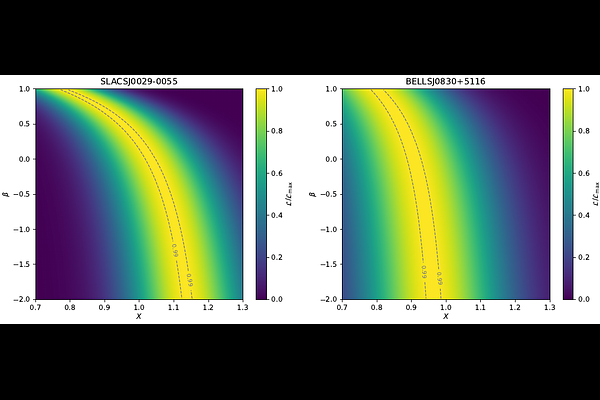
AbstractStrong gravitational lensing combined with stellar dynamics provides a complementary route for testing gravity on kiloparsec scales and probing the internal structure of massive galaxies. However, such studies remain limited by degeneracies among the mass-density profile, stellar orbital anisotropy and external convergence, and by modelling assumptions, especially when only single-aperture velocity dispersions are available. Here we develop a hierarchical Bayesian framework to disentangle gravity and stellar orbital anisotropy from other effects at the population level. By reconstructing the lens mass distribution with a flexible broken power-law model and propagating its posterior uncertainty into the predicted velocity dispersion, we obtain a likelihood for each lens in the plane of stellar orbital anisotropy and an effective mismatch parameter. This parameter encapsulates projection bias, external convergence, cosmological distance ratios and deviations from general relativity via the post-Newtonian parameter $γ_{\rm PPN}$. Applying this framework to 121 galaxy-scale lenses, we find $γ_{\rm PPN}=1.027^{+0.099}_{-0.095}$, consistent with general relativity, and obtain $2σ$ evidence that the stellar orbits of massive galaxies have become more radially biased over the past $\sim6$ Gyr. Forecasts show that future samples of order $10^5$ lenses could enable sub-percent tests of gravity, precise measurements of orbital-structure evolution and complementary constraints on the cosmological matter-density parameter.