Atmospheric diversity of sub-Neptunes from formation with rock, water, and soot

Atmospheric diversity of sub-Neptunes from formation with rock, water, and soot
Caroline Dorn, Aaron Werlen, Sean Jordan
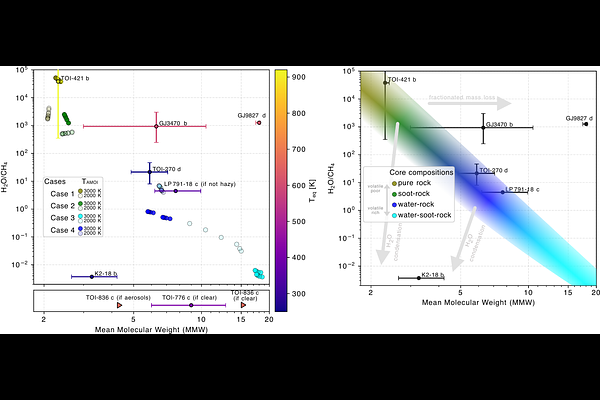
AbstractRecent JWST detections of CH4 and CO2 in sub-Neptune atmospheres point to a link between atmospheric composition and the nature of planetary building blocks - rock, water, or refractory carbon ("soot") - yet this connection remains poorly understood. Here we investigate how different formation environments shape the coupled interior and atmospheric compositions of sub-Neptunes. We model planets assembled from varying proportions of rock, water, and soot and compute the global chemical equilibrium and the overlying atmospheric structure. We find that planets formed from water-poor material produce atmospheres strongly depleted in carbon-bearing species, with log(CH4) and log(CO2) below -4. In contrast, planets assembled from water-rich building blocks naturally develop methane- and carbon-dioxide-rich atmospheres with elevated metal mass fractions and C/O ratios. The presence of refractory carbon (soot) further enhances methane production and can lead to methane-dominated atmospheres. Comparison with JWST observations suggests that water-rich formation is sufficient to explain K2-18b and TOI-270d with no soot component required, while TOI-421b and GJ3470b are consistent with water-poor formation inside the water ice line. The ratio H2O/CH4 combined with the mean molecular weight (MMW) provides a powerful two-dimensional diagnostic linking atmospheric composition to formation environment, with departures from the predicted trends explained by water condensation in temperate atmospheres or fractionated atmospheric mass loss.