Inflationary Phase Transitions in the Early Universe: A Bayesian Study with Space-Based Gravitational Waves Detectors

Inflationary Phase Transitions in the Early Universe: A Bayesian Study with Space-Based Gravitational Waves Detectors
Qingyuan Liang, Chen Yang, Haipeng An, Huai-Ke Guo
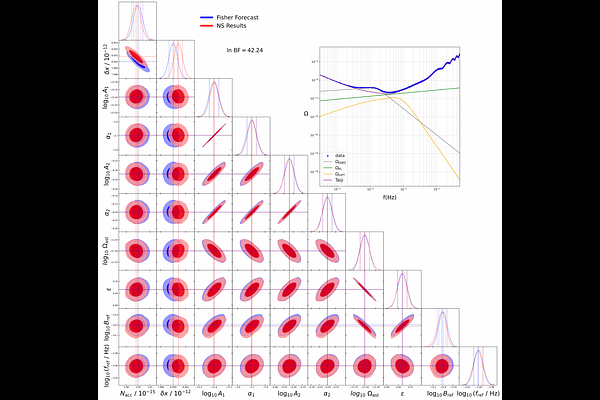
AbstractPhase transitions during inflation can generate a stochastic gravitational-wave background that probes primordial physics. We study the detectability and parameter reconstruction of such a signal with a space-based gravitational-wave detector. Using a Taiji-like mission as a benchmark, we construct a realistic data-analysis framework that includes instrumental noise, astrophysical foregrounds and backgrounds, and the $A$, $E$, and $T$ time-delay interferometry channels. The target signal is described in a minimal, model-independent form and analyzed using both Fisher-matrix forecasts and Bayesian inference with nested sampling. We quantify detection significance and parameter-recovery thresholds, showing that while detection is achievable at moderate signal-to-noise ratios, stronger signals provide more reliable parameter reconstruction. These results offer a realistic assessment of the capability of future space-based missions to probe phase transitions during inflation through stochastic gravitational radiation.