NOEMA3D: Resolving radial gas flows in disk galaxies at z~1.1-1.6 with high-resolution CO observations

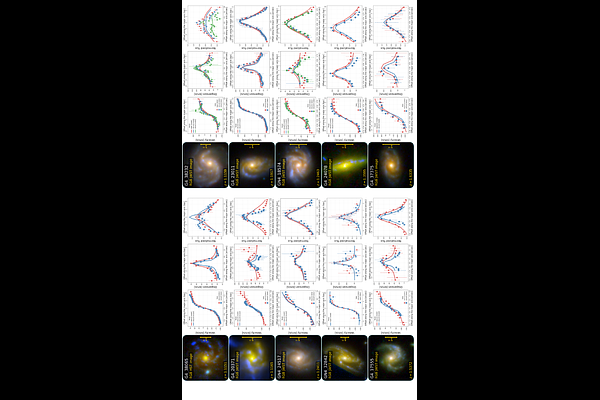
NOEMA3D: Resolving radial gas flows in disk galaxies at z~1.1-1.6 with high-resolution CO observations
Jean-Baptiste Jolly, Linda J. Tacconi, Reinhard Genzel, Roberto Neri, Karl Schuster, Jianhang Chen, Natascha M. Förster Schreiber, Stavros Pastras, Letizia Scaloni, Giulia Tozzi, Capucine Barféty, Alberto Bolatto, Andreas Burker, Françoise Combes, Pierre Cox, Ric Davies, Frank Eisenhauer, Juan Manuel Espejo Salcedo, Rodrigo Herrera-Camu, Santi García-Burillo, Tadayuki Kodama, Lilian Lee, Minju M. Lee, Daizhong Liu, Dieter Lutz, Giovanni Mazzolari, Thorsten Naab, Amit Nestor Shachar, Claudia Pulsoni, Alvio Renzini, Monica Rubio, Taro T. Shimizu, Amiel Sternberg, Eckhard Sturm, Hannah Übler, Antonio Usero, Stijn Wuyts
AbstractWe present NOEMA3D, a unique high-resolution study of purely molecular gas kinematics at $z \sim 1.1$ to 1.6, providing a dedicated view of cold gas dynamics at the late stages of the peak epoch of cosmic star formation. Using deep ($gtrsim 20$ hr on source per target) IRAM-NOEMA CO observations of 10 massive ($10.45 < log(M^*/M_\odot) < 11.43$) ) main-sequence galaxies, complemented by high-resolution JWST imaging, we resolve the molecular gas kinematics and morphology on kiloparsec scales. We find that all galaxies exhibit ordered rotation with moderate intrinsic turbulence (median $σ_0 \sim 32 \pm 10$ km/s, median $V_c/σ_0 \sim 8.6 \pm 2.9$), consistent with dynamically turbulent disks at late cosmic noon. After modeling the axisymmetric rotation with the forward-modeling code DysmalPy, we reveal spatially coherent velocity residuals in all but one more inclined system. The inferred in-plane non circular motions reach amplitudes of $\sim 50$-100 km/s, significantly larger than typically observed in local disk galaxies. Interpreting these non-circular motions as radial flows we find that the velocity residuals spatially coincide with non-axisymmetric structures -- spiral arms and bars -- demonstrating a direct link between galaxy morphology and gas transport at $z \sim 1$-2. In spiral galaxies, the residual velocity patterns are typically dominated by inflows, while barred systems display an apparent inflow-outflow pattern, characteristic of in-plane bar-driven gas motions. We further find that the inferred molecular gas inflow rates are substantial, with a typical net inflow rate of the order of the star formation rate ( $\dot M \sim -50 M_\odot/$yr). This implies that spiral arms and bars at cosmic noon are highly efficient at funneling cold gas toward galaxy centers, perhaps driving the buildup of bulges and feeding central star forming regions and supermassive black holes.