Rapid and Predictive Planet Population Synthesis Model (RAPPS) I. Upgraded model and resulting synthetic populations

Rapid and Predictive Planet Population Synthesis Model (RAPPS) I. Upgraded model and resulting synthetic populations
Tadahiro Kimura, Masahiro Ikoma
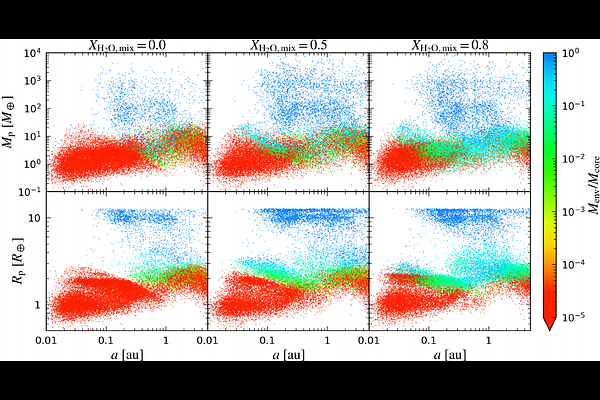
AbstractExoplanet surveys have revealed a wide diversity of planetary systems, requiring integrated models of planet formation to explain their origin. Planet population synthesis (PPS) modelling is a key tool for linking theory with the statistical properties of observed exoplanets. In the coming decade, the number of known exoplanets is expected to increase ten-fold, with a significant expansion in the range of planetary parameters probed by upcoming missions. We aim to develop a new PPS model capable of predicting planetary masses, radii, orbits, and atmospheric properties across diverse stellar hosts, while maintaining high computational efficiency for statistical comparison with observations. We build upon our previous model, which included water enrichment of primordial atmospheres via magma-gas interactions, and extend it by incorporating a semi-analytical treatment of post-disc dynamical evolution in multiplanet systems. Additional updates include revised prescriptions for disc evolution, resonance trapping, and atmospheric escape. The updated model produces planetary distributions that differ from our previous results, particularly in the abundance of Earth- and sub-Earth-mass planets. These differences arise mainly from the new dynamical evolution model and show improved agreement with simulations based on direct N-body integrations. Atmospheric enrichment is also found to strongly influence both the occurrence of gas giants and the radius distribution of close-in super-Earths and sub-Neptunes. The upgraded model provides a computationally efficient and physically comprehensive framework for predicting planetary populations across a wide range of stellar environments, enabling large parameter surveys and robust statistical comparisons with observations.