The evolution and internal structure of Neptunes and sub-Neptunes II. Convective mixing and thermal conductivity

The evolution and internal structure of Neptunes and sub-Neptunes II. Convective mixing and thermal conductivity
Mark Eberlein, Ravit Helled
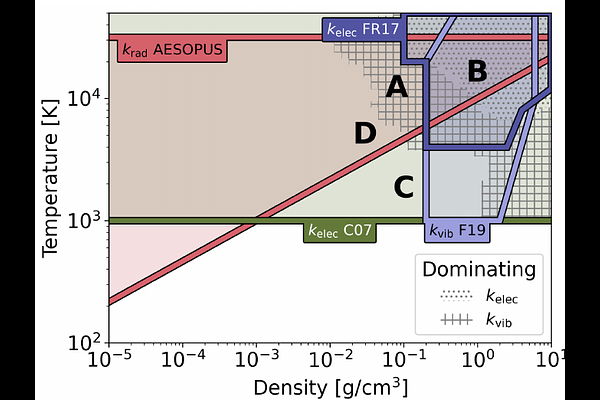
AbstractSub-Neptunes and Neptunes are often modeled with distinct, fully convective layers. Yet, there are several arguments for compositions gradients that can inhibit convection. In these regions, energy transport depends on the thermal conductivity and radiative opacity. We compare three thermal conductivity models and investigate their impact on planetary evolution accounting for the possibility of convective mixing eroding composition gradients. Using a modified version of MESA, we model the evolution of planets with masses of Mp=5, 10, 15 Mearth and three initial entropies. We implement thermal conductivities for: pure water, fully ionized matter, and constant electron conductivity. Convective mixing complicates the relation between conductivity, evolution, and radius. For hot forming planets with a large composition gradient, where the heavy-element mass fraction changes gradually from the core to the envelope, convective mixing has a large impact on the radius evolution. In this case, the thermal conductivity is less relevant and the radii converge to similar values after billions of years. For cold forming planets or narrow composition gradients, convective mixing is less efficient. If the composition profile is not altered significantly, the thermal conductivity becomes critical. It determines how much energy can be trapped beneath stable composition gradients. For intermediate initial entropies, high thermal conductivity inhibits convection. Further work is required to determine the thermal conductivity for various mixtures expected in sub-Neptune and Neptunes at high densities and temperatures. In addition, further constraints on the entropy and composition profile after formation can reduce the degeneracy of the planetary evolution, in particular, the dependence of the radius with time.