The MBW complex regulates volatiles in petunia flowers: EOBV interacts with AN1 to suppress biosynthesis of phenylpropenes

The MBW complex regulates volatiles in petunia flowers: EOBV interacts with AN1 to suppress biosynthesis of phenylpropenes
Skaliter, O.; Cohen, R.; Leor-Librach, E.; Shor, E.; Rudich, O.; Edelbaum, O.; Shklarman, E.; Masci, T.; Vainstein, A.
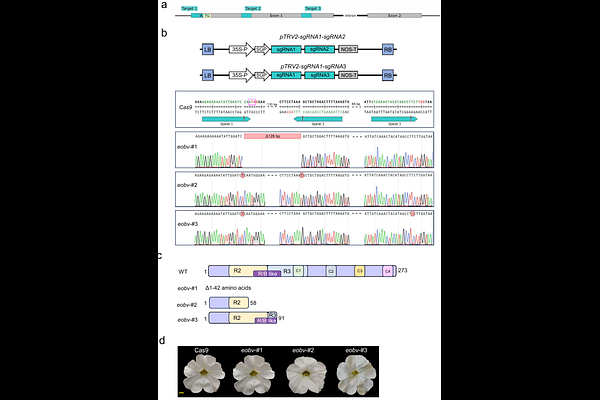
AbstractPigment production in petunia is regulated by the bHLH AN1 and the WDR protein AN11, which together with interchangeable MYBs form the MYB-bHLH-WDR (MBW) complex. Pigments and scent are interlinked flower traits, produced via the phenylpropanoid pathway. However, involvement of the MBW complex in regulating floral scent has not been demonstrated. TRV-based suppression of either AN1 or AN11 led to an increase in volatile emission, indicating that they are involved in negative regulation of this trait. Yeast two-hybrid and in-planta pairwise and three-way protein-protein interaction assays revealed that EMISSION OF BENZENOIDS V (EOBV) is a component of the MBW complex. Headspace and internal pool analyses of flowers from eobv-knockout lines, generated using a viral-based CRISPR/Cas9 system, revealed that EOBV fine-tunes volatile production: phenylpropene levels increased while those of benzenoids and phenylpropanoid-related compounds decreased. Accordingly, transcript levels of C4H, directing carbon flux to phenylpropenes, and ADT3 were significantly elevated in eobv flowers, along with decreases in PAAS and BSMT. EOBV is heat-responsive and under a high-temperature regime, in addition to its involvement in scent production, it affected flower development by mitigating reduction of flower size. The participation of EOBV in the MBW complex that regulates volatiles and anthocyanins reveals an intriguing molecular link between these showy traits and flower development.