Early-life optimization of mitochondrial aerobic metabolism: high efficiency to grow fast, yet at no oxidative cost

Early-life optimization of mitochondrial aerobic metabolism: high efficiency to grow fast, yet at no oxidative cost
Lenoel, L.; Roussel, D.; Barbe, J.; Claire, A.; Averty, L.; Calandreau, L.; STIER, A.
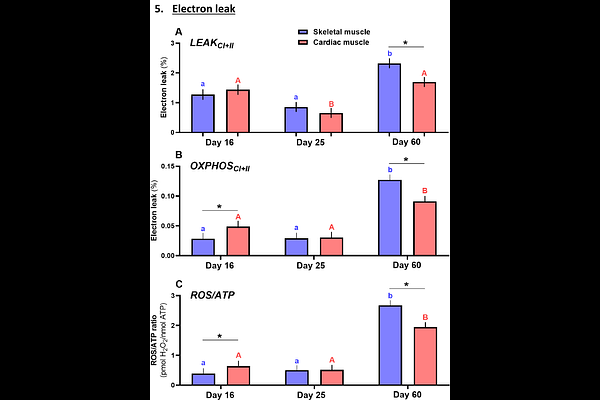
AbstractVariation in mitochondrial aerobic metabolism has been suggested to underlie variation in interindividual performance. Mitochondrial efficiency quantifies, directly or indirectly, the amount of adenosine triphosphate (ATP) produced relative to O2 consumption. High mitochondrial efficiency is theoretically beneficial by providing more ATP per amount of resource consumed, but may come at the cost of increased reactive oxygen species (ROS) production damaging tissues through oxidative stress. Mitochondrial efficiency is a plastic trait but how it changes through postnatal development remains unknown. We hypothesized that strong selective pressure could lead to an increased mitochondrial efficiency to support fast growth but incur an oxidative cost. We tested this hypothesis by quantifying mitochondrial aerobic metabolism, efficiency and ROS production through postnatal growth in Japanese quail (Coturnix japonica), in two highly aerobic tissues: skeletal and cardiac muscles. Mitochondrial efficiency was indeed higher during peak growth in both tissues, but this was surprisingly associated with markedly lower ROS production. This high efficiency was likely achieved via both a lower proton leak and a higher contribution of complex I to respiration. These results show that enhancing mitochondrial efficiency may be important to support growth, but suggest the presence of unexpected ROS mitigation processes during early-life growth.