The Friendship Paradox across animal social systems is governed by network structure and biological features

The Friendship Paradox across animal social systems is governed by network structure and biological features
Newman, E. F.; Knowles, S. C. L.; Firth, J. A.
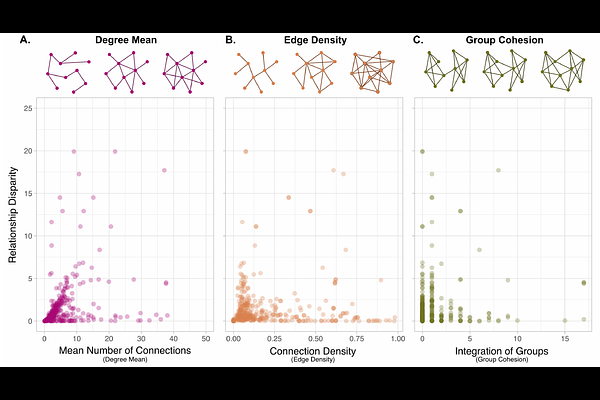
AbstractA population's social structure, often represented as a social network, shapes fundamental biological processes including the spread of disease, information, and behaviour. The 'Friendship Paradox' is a network phenomenon whereby the average individual has fewer 'friends' than their 'friends' do. This effect can be quantified as relationship disparity (the difference between an individual's connectedness and those they are connected to) which captures the local social environment. Previous work has shown that such relationship disparity can be exploited in effective outbreak monitoring, targeted health interventions and optimized contact tracing. Yet, how its magnitude varies across real-world social networks remains poorly understood. Here, we analyse relationship disparity across 391 empirical animal social networks to test how intrinsic network properties and biological attributes predict its extent. We find that smaller and sparser networks exhibit stronger relationship disparity, and that mammalian and avian social systems generally showed stronger relationship disparity than reptilian systems. After controlling for variation in individual sociability, mammalian and reptilian social networks displayed weaker relationship disparity than expected based on network structure alone. Together, these findings demonstrate that both network structure and biological attributes shape relationship disparity in natural social systems, providing a foundation for predicting how higher-order network architecture influences social processes such as contagion.