The Anaeramoeba symbiosome: a single contiguous organelle that doubles the cell's membrane surface

The Anaeramoeba symbiosome: a single contiguous organelle that doubles the cell's membrane surface
Jerlstrom Hultqvist, J.
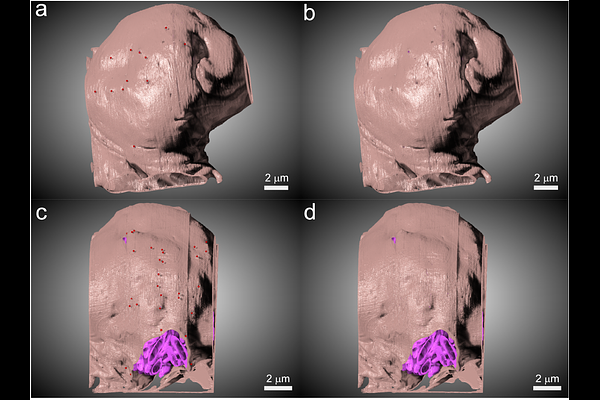
AbstractAnaerobic protists across diverse lineages have independently evolved intimate spatial associations between their hydrogen-producing mitochondrion-related organelles and prokaryotic symbionts, yet the cellular structures mediating these syntrophic partnerships remain poorly characterized. Anaeramoebae - a recently described phylum of anaerobic amoeboflagellates - have evolved a particularly elaborate solution: the symbiosome, a membrane organelle that houses sulfate-reducing Desulfobacter sp. symbionts alongside host hydrogenosomes and maintains direct connections to the extracellular environment. Previous FIB-SEM work using aldehyde-based fixation established the symbiosome as a dynamic structure but left critical architectural questions unresolved, including whether symbionts occupy separate compartments and how extensive the connections to the cell exterior truly are. Here, we use high-pressure freezing with optimized cultivation to achieve markedly improved membrane preservation in Anaeramoeba flamelloides. We show that the symbiosome is a single, fully interconnected compartment enclosing all Desulfobacter sp. symbionts, spanning up to 15% of total cell volume with a membrane surface area matching that of the plasma membrane. The number of symbiosome-to-surface connections is an order of magnitude higher than previously documented - 12 and 29 pores in two cells, compared with three in the earlier volume - likely reflecting the metabolic requirement for extracellular sulfate access by the symbionts. These findings establish the Anaeramoeba symbiosome as one of the largest known membrane organelles in a single-celled eukaryote, with an architecture shaped by the demands of syntrophic exchange.