Illuminating the Local Universe: Large-Scale Structure from ZTF Type Ia Supernovae

Illuminating the Local Universe: Large-Scale Structure from ZTF Type Ia Supernovae
Antoine Gilles Lordet, Ariel Goobar, Jens Jasche, Stuart McAlpine, Jesper Sollerman, Young-Lo Kim, Mickael Rigault, Madeleine Ginolin, Umut Burgaz, Eric C. Bellm, Matthew J. Graham, Joahan Castaneda Jaimes, Frank J. Masci, Josiah Purdum, Reed Riddle
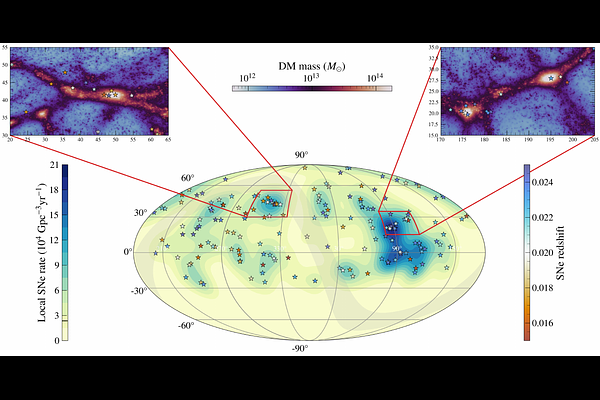
AbstractWithin the volume-limited subsample at $z<0.06$ of the Zwicky Transient Facility (ZTF) DR2 sample, we confirm a statistically significant excess of Type Ia supernovae (SNe Ia) at $z \simeq 0.02$-$0.04$, previously reported but not explained by survey selection effects. Forward simulations assuming a uniform volumetric SN Ia rate and realistic ZTF detection efficiencies fail to reproduce the feature at the $5$-$7σ$ level. We also detect an excess in the rates compared to our survey simulations at $z \simeq 0.08$ and $0.14$, albeit at smaller significance. To investigate the origin of these inhomogeneities, we compare the observed SN distribution to constrained reconstructions of the local matter density field from the Manticore project, based on Bayesian forward modelling of the 2M++ galaxy catalogue. While SN overdensities are spatially associated with prominent nearby structures such as the Perseus, Coma, and Hercules superclusters, the amplitude of the SN excesses significantly exceeds that expected from matter overdensities alone. By reconstructing a redshift-dependent volumetric SN Ia rate, we find that local enhancements can reach factors of two to five within specific clusters, while the sample-averaged rate remains consistent with previous low-redshift measurements. These results indicate that the SN Ia rate is not a linear tracer of the underlying matter density and suggest a strong environmental dependence in dense structures. We discuss possible physical origins and highlight the implications for low-redshift SN cosmology, including correlated peculiar velocities and additional covariance beyond standard linear corrections.