Mechanical interaction enables a collective mode of protocell proliferation

Mechanical interaction enables a collective mode of protocell proliferation
Wu, Y.; Li, Y.
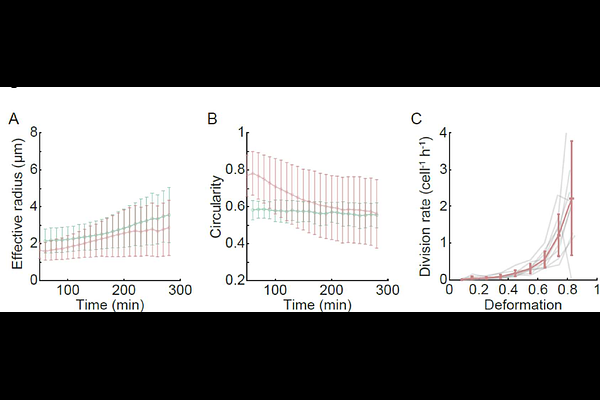
AbstractThe proliferation of primitive life-forms (known as protocells) without sophisticated cell-division molecular machineries has been an intriguing question in evolutionary biology, synthetic biology, and living matter physics. While various modes of protocell proliferation at the individual level have been proposed, the growth dynamics of protocell colonies (i.e., protocolonies) received less attention. Here we chose to study this question in protocolonies consisting of densely packed protocells derived from wall-deficient L-form bacteria. We discovered that protocolonies proliferated robustly under spatial confinement, while isolated protocells failed to divide and eventually experienced membrane rupture due to imbalance of surface and volume growth. Combining results from quantitative imaging and computational modeling, we attributed this unexpected finding to mechanical shearing between densely packed protocells driven by their growth activities; such mechanical shearing enhances cell deformation, thereby enabling cell division and sustaining population growth in a protocolony. Our study reveals a unique role of self-generated mechanical stresses in the lifestyle of primitive life-forms. The findings may help to understand and control the collective growth dynamics of synthetic protocells or active droplets.