Network reconfiguration preserves prediction error signallingin the aging brain

Network reconfiguration preserves prediction error signallingin the aging brain
Andersen, M. H.; Fernandez-Rubio, G.; Quiroga-Martinez, D. R.; Rosso, M.; Klarlund, M.; Larsen, K. M.; Siebner, H. R.; Kringelbach, M. L.; Vuust, P.; Bonetti, L.
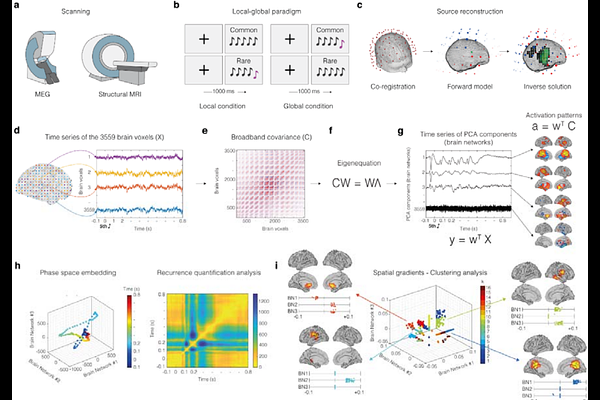
AbstractCognitive aging is widely associated with a progressive weakening of predictive brain mechanisms. This view is supported by decades of electrophysiological studies reporting attenuated mismatch responses in older adults. Yet the literature remains inconsistent, suggesting that aging may not uniformly attenuate predictive processing. One possibility is that multiple predictive subsystems operate concurrently but have rarely been disentangled. Here we address this question by separating whole-brain networks underlying predictive processing in source-reconstructed magnetoencephalography (MEG) data from 77 younger and older adults performing the auditory local-global paradigm. Network decomposition revealed three temporally overlapping predictive subsystems with distinct functional profiles. Aging exerted selective effects across these networks. Sensory prediction error responses were enhanced within a network linking auditory cortices with medial cingulate regions, whereas responses associated with reorientation of attention and contextual pattern processing were attenuated in older adults. The level of multivariate recurrency across these networks was preserved with aging, while the processing of sensory violations induced more recurrency and less divergence relative to contextual violations in both groups. These findings challenge the prevailing view that predictive processing simply declines with age. Instead, aging redistributes predictive resources across distinct neural systems, amplifying sensory-based processes while weakening more cognitively demanding predictive mechanisms.