Unveiling the Local Environment of FRB 20220912A: Sub-arcsecond $4-26$ GHz Radio Continuum Mapping

Unveiling the Local Environment of FRB 20220912A: Sub-arcsecond $4-26$ GHz Radio Continuum Mapping
Yash Bhusare, Yogesh Maan, Mohit Bhardwaj, Thomas C. Abbott, Yuxin Dong, Danté M. Hewitt, Afrokk Khan
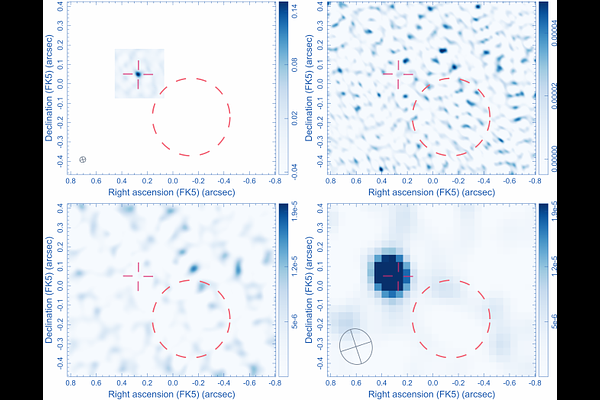
AbstractThe local environments of repeating fast radio bursts (FRBs) provide critical clues to their progenitors. While some active repeaters (e.g., FRB~20121102A, FRB~20190520B) are embedded in compact persistent radio sources (PRS), others appear to reside in cleaner environments. We present a high-resolution, multi-frequency (4$-$26 GHz) continuum study of the hyperactive repeater FRB 20220912A using the Karl G. Jansky Very Large Array (VLA). We report the discovery of a previously unknown radio source distinct from the compact PRSs seen in other FRBs, spatially coincident with the FRB position and offset by $\approx 300$~mas ($\approx 450$~pc) from the host galaxy's center. The absence of continuum emission in archival milliarcsecond-resolution VLBI observations indicates that the source is resolved out, ruling out a hyper-compact ($< 1$~pc) central-engine-powered origin. We constrain the physical diameter of the emitting region between 75~pc and 190~pc. We further demonstrate that the source is characterized by a steep non-thermal spectral index ($α\approx -0.73$) and a remarkably high star-formation rate surface density $Σ_{\text{SFR}} \gtrsim 13~M_{\odot}~\text{yr}^{-1}~\text{kpc}^{-2}$. We argue that this emission is best explained as a compact star-forming region within the host galaxy. This association with a site of ongoing star formation provides strong observational support for the hypothesis that young magnetars, formed after the deaths of massive stars, are the progenitors of at least some repeating FRBs.