Simultaneous TCR and IL-2 agonism selectively enhances epitope-specific CD8 T cell responses during chronic viral infection

Simultaneous TCR and IL-2 agonism selectively enhances epitope-specific CD8 T cell responses during chronic viral infection
Hashimoto, M.; Khan, M. A.; Akhtar, A.; Agrewala, J. N.; Freeman, G.; Girgis, N.; Zhang, Y.; Low, S.; Quayle, S. N.; Suri, A.; Ahmed, R.
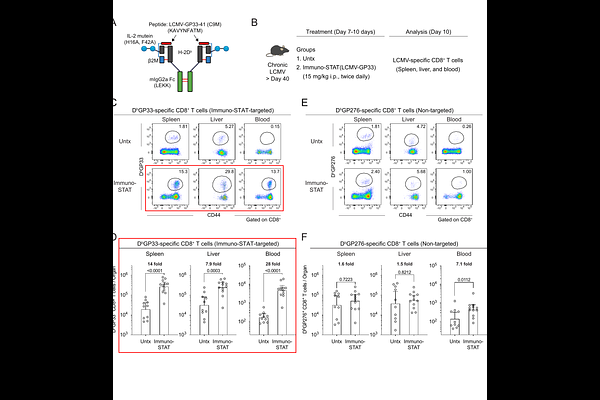
AbstractInterleukin-2 (IL-2) remains an attractive cytokine for enhancing antigen-specific CD8 T cell responses in cancer immunotherapy, but systemic toxicity hinders its broad clinical application. To address this, various IL-2-based therapeutics have been engineered with altered IL-2 receptor bias or targeted delivery to tumors, the tumor microenvironment, or immune cell populations. Ideally, IL-2 signals should be selectively delivered to antigen-specific CD8 T cells, boosting their responses and promoting effector differentiation while sparing non-targeted populations. Immuno-STATTM (Selective Targeting and Alteration of T cells) is a fusion protein platform comprising a bivalent peptide-MHC class I complex and an affinity-attenuated IL-2 mutein that co-stimulates TCR and IL-2 signaling in epitope-specific CD8 T cells. Here, we investigated whether a DbGP33-41-targeted Immuno-STAT enhances DbGP33-specific CD8 T cell responses in a mouse model of chronic lymphocytic choriomeningitis virus (LCMV) infection. Immuno-STAT treatment selectively expanded DbGP33-specific CD8 T cells with an effector-like phenotype. Non-targeted DbGP276-specific CD8 T cells showed little to no expansion in response to DbGP33-41-targeted Immuno-STAT therapy, underscoring the selectivity of this approach. However, minor changes in phenotypic markers, including increased expression of CD25 and CX3CR1, were observed in non-targeted CD8 T cells, likely reflecting bystander IL-2 signaling. Combining Immuno-STAT with PD-1 blockade augmented DbGP33-specific CD8 T cell responses more effectively than PD-1 blockade alone, with minor effects on the non-targeted DbGP276-specific population. These findings inform the clinical development of Immuno-STAT and other IL-2 therapeutics and highlight the value of coordinated TCR and IL-2 stimulation during chronic antigen exposure, alone or in combination with PD-1 blockade.