Charge transfer from ammonia neutralizes propylene oxide cations: Implications for the astrochemistry of chiral molecules

Charge transfer from ammonia neutralizes propylene oxide cations: Implications for the astrochemistry of chiral molecules
Sanjana Maheshwari, Darya Kisuryna, Leah G. Dodson
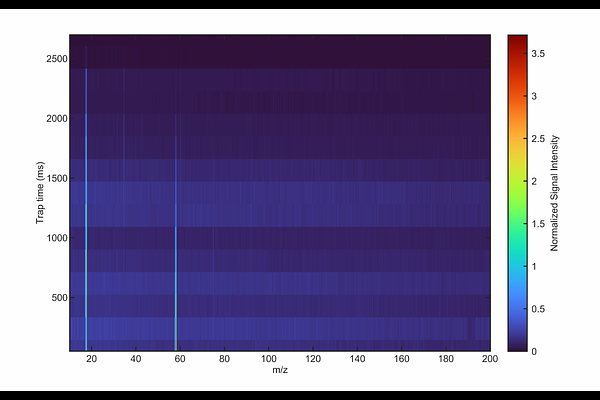
AbstractTo date only one chiral species, propylene oxide, has been observed in the interstellar medium but little is known about the chemistry that leads to a detectable abundance of this molecule in Sagittarius B2. We used a glow-discharge ion source and a room-temperature ion trap to study the neutralization reactions necessary to convert propylene oxide cation (PO$^+$) -- the assumed precursor for propylene oxide in space -- into the observed astrochemical. We found that the charge-transfer reaction between PO$^+$ and ammonia (NH$_3$) proceeds with a pressure-independent rate coefficient of $(1.39\pm0.03)\times10^{-12}$ cm$^{3}$ s$^{-1}$ to neutralize PO$^+$ and form the radical cation NH$_3$. Although this measured rate coefficient is much slower than that predicted by capture theories, the high abundance of NH$_3$ in Sagittarius B2 motivates the inclusion of this reaction in astrochemical models. We hypothesize that the low ionization energies of many chiral molecules important to origin-of-life theories means these species may exist as cations in the interstellar medium.