Unlocking HST's Stellar Treasure Trove: Stellar Activity Minima for HAT-P-11 Offer Prime Windows for Transmission Spectroscopy

Unlocking HST's Stellar Treasure Trove: Stellar Activity Minima for HAT-P-11 Offer Prime Windows for Transmission Spectroscopy
Prajwal Niraula, Benjamin V. Rackham, Julien de Wit, Daniel Apai, Mark S. Giampapa, David Berardo, Chia-Lung Lin
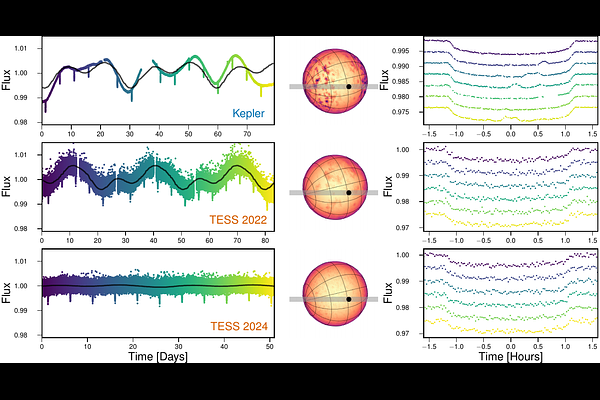
AbstractHAT-P-11 is a well-studied, active K dwarf hosting an eccentric, misaligned transiting sub-Neptune. As part of the HST Stellar Treasure Trove program (HST-AR-17551), we analyze absolutely calibrated out-of-transit \HST{} spectra from \texttt{STIS} and \texttt{WFC3} across the \textsc{G430L}, \textsc{G750L}, \textsc{G102}, and \textsc{G141} bandpasses to constrain the surface heterogeneity of HAT-P-11 and its impact on transmission spectroscopy. Grid-based spectral retrievals using NewEra \texttt{PHOENIX} models robustly favor two-component photospheres in the \texttt{WFC3} G102 and G141 data, with a ${\sim}4950$\,K photospheric component and a cooler ($\sim$3400\,K) component covering 26{--}33\% of the stellar disk. By contrast, retrievals on the \texttt{STIS} optical spectra do not yield a satisfactory fit, reflecting current limitations of stellar atmosphere models in the optical regime compared to the \HST{} observational precision. We contextualize these results using long-term photometric monitoring and chromospheric activity indices. The inferred high spot covering fractions are broadly consistent with the elevated photometric variability observed during the \textit{Kepler} era ($f_{\rm spot}$$\sim$10--20\%) but are in tension with the much lower rotational amplitudes observed from TESS in the mid 2020s ($f_{\rm spot}$$\sim$1--10\%). This secular decline in variability is mirrored by a $\sim$20\% decrease in the Ca\,\textsc{ii} H\&K index. These results imply that HAT-P-11 undergoes comparatively quiescent phases that offer more favorable windows for atmospheric characterization, which serendipitously coincided with some of the recent JWST observations. More generally, our study demonstrates that multi-epoch, space-based stellar spectra provides a physically grounded pathway for mitigating stellar contamination in high-precision transmission spectra in the JWST era.