Short-Term Turbulence Prediction for Seeing Using Machine Learning

Short-Term Turbulence Prediction for Seeing Using Machine Learning
Mary Joe Medlej, Rahul Srinivasan, Simon Prunet, Aziz Ziad, Christophe Giordano
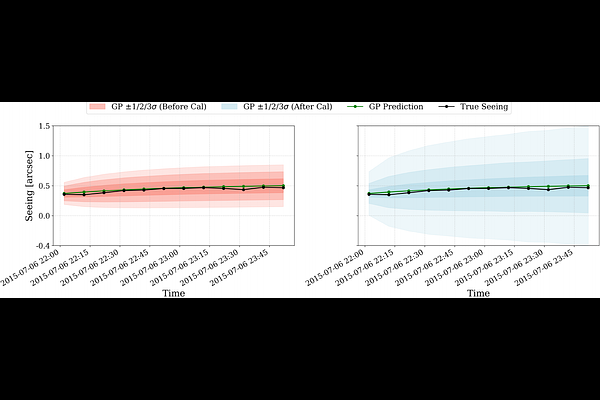
AbstractOptical turbulence, driven by fluctuations of the atmospheric refractive index, poses a significant challenge to ground-based optical systems, as it distorts the propagation of light. This degradation affects both astronomical observations and free-space optical communications. While adaptive optics systems correct turbulence effects in real-time, their reactive nature limits their effectiveness under rapidly changing conditions, underscoring the need for predictive solutions. In this study, we address the problem of short-term turbulence forecasting by leveraging machine learning models to predict the atmospheric seeing parameter up to two hours in advance. We compare statistical and deep learning approaches, with a particular focus on probabilistic models that not only produce accurate forecasts but also quantify predictive uncertainty, crucial for robust decision-making in dynamic environments. Our evaluation includes Gaussian processes (GP) for statistical modeling, recurrent neural networks (RNNs) and long short-term memory networks (LSTMs) as deterministic baselines, and our novel implementation of a normalizing flow for time series (FloTS) as a flexible probabilistic deep learning method. All models are trained exclusively on historical seeing data, allowing for a fair performance comparison. We show that FloTS achieves the best overall balance between predictive accuracy and well-calibrated uncertainty.