A Post-starburst Galaxy Undergoing Ram-pressure Stripping at Redshift 3.06

A Post-starburst Galaxy Undergoing Ram-pressure Stripping at Redshift 3.06
Mingyu Li, Zheng Cai, Bjorn H. C. Emonts, Fengwu Sun, Ming Sun, Fuyan Bian, Zihao Li, Xiaojing Lin, Yunjing Wu, Franz E. Bauer, Seiji Fujimoto, Anton M. Koekemoer, Vasily Kokorev, Christopher N. A. Willmer, Eiichi Egami, Xiaohui Fan, J. Xaiver Prochaska, Zechang Sun, Fujiang Yu
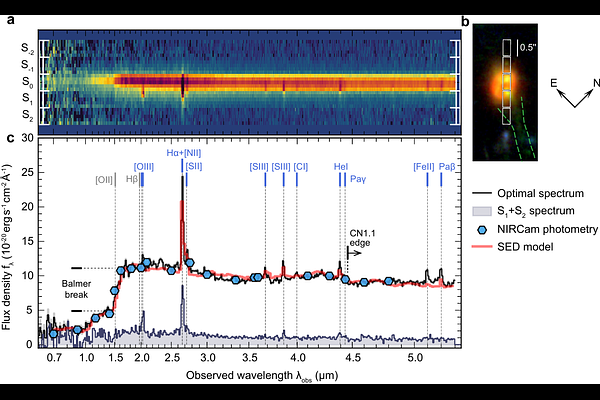
AbstractUnderstanding how galaxies ignite and extinguish their star formation remains a cornerstone question in modern astrophysics. Recent JWST surveys have revealed an overabundance of massive quiescent galaxies in the first billion years of the Universe, challenging current models of galaxy evolution. In the nearby Universe, ram pressure stripping (RPS) is a major environmental mechanism capable of rapidly shutting down star formation, yet direct observation remains scarce at redshift $z\gtrsim1$, and its role at $z>2$ is even poorly constrained by simulations. Here, we utilize JWST and ALMA observations to present direct evidence of RPS in the post-starburst galaxy A2744-JF-z3, residing in a galaxy group at redshift 3.06, the earliest such detection to date. Spectroscopic diagnostics and spectral energy distribution modeling reveal the ongoing removal of cold gas and dust, coincident with the abrupt cessation of star formation. Contrary to hydrodynamical simulations that predict a reduced incidence of RPS at high redshift, our results instead imply that RPS can operate at $z>3$, suggesting a highly stochastic and impulsive stripping within a clumpy, filamentary intra-group and circumgalactic medium. These observations extend environmental quenching well into the epoch of galaxy assembly, highlighting RPS as a previously overlooked decisive pathway to rapid quenching in nascent groups and protoclusters in the early Universe.