Ontogenetic expansion and regionalization of the triatomine compound eye supports flight-related vision

Ontogenetic expansion and regionalization of the triatomine compound eye supports flight-related vision
Chialina, T. M.; Gentili, H. G.; Minoli, S. A.; Beron de Astrada, M.
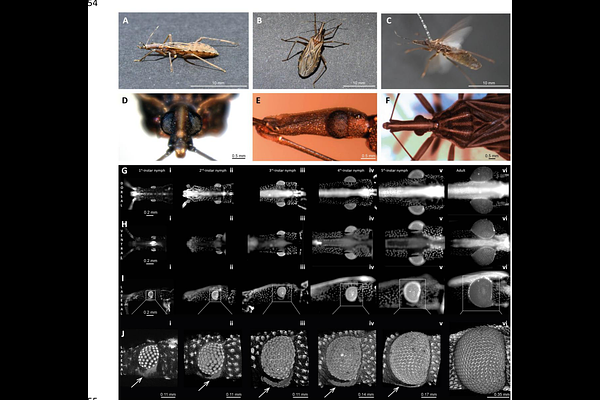
AbstractTriatomines are the vectors of Chagas disease, one of the main endemic diseases from South to North America, now expanding to other continents. These hemimetabolous insects have been considered poorly visual animals. However, recent findings challenge this idea. Here, we used Rhodnius prolixus as a model species to comprehensively characterize triatomine compound eyes. We found that in the adult stage, eye size significantly exceeds the dimensions predicted by the nymphal eye growth rate. Moreover, while the compound eye grows symmetrically in its dorsal and ventral directions throughout the nymphal instars, in the adult, the eye undergoes greater ventral growth, resulting in a dorsoventrally asymmetrical eye. By studying a bright pseudopupil induced by fluorescence in natural mutant animals, we observed no major differences in sampling resolution between the last nymphal instar and the adult stage. However, the adult eye possesses significantly larger ommatidia, particularly in its ventral region, shifting the area of highest sensitivity from the equatorial region in the nymphal instars to the ventral region in the adult. A similar eye growth pattern was observed in Triatoma infestans and Panstrongylus megistus. The analysis of photographic records from 39 species across 10 genera indicates that an asymmetrical eye is the predominant phenotype in adult triatomines. Notable exceptions in wingless adults of Mepraia spinolai, reveal a tight association between possessing a large asymmetrical eye and the presence of wings. This suggests that vision might support triatomine dispersal flights among other visual behaviors.