The Structure of Molecular Gas in PHANGS-ALMA Galaxies: Cloud Spacing, Two-Point Correlation and Stacked Intensity Profiles

The Structure of Molecular Gas in PHANGS-ALMA Galaxies: Cloud Spacing, Two-Point Correlation and Stacked Intensity Profiles
Hao He, Adam Leroy, Erik Rosolowsky, Annie Hughes, Jiayi Sun, Joshua Machado, Frank Bigiel, Ashley Barnes, Zein Bazzi, Yixian Cao, Melanie Chevance, Dario Colombo, Simon C. O. Glover, Jonathan D. Henshaw, Eric W. Koch, Sharon E. Meidt, Hsi-An Pan, Toshiki Saito, Sumit K. Sarbadhicary, Eva Schinnerer, Rowan J. Smith, Antonio Usero, David H. Weinberg, Thomas G. Williams
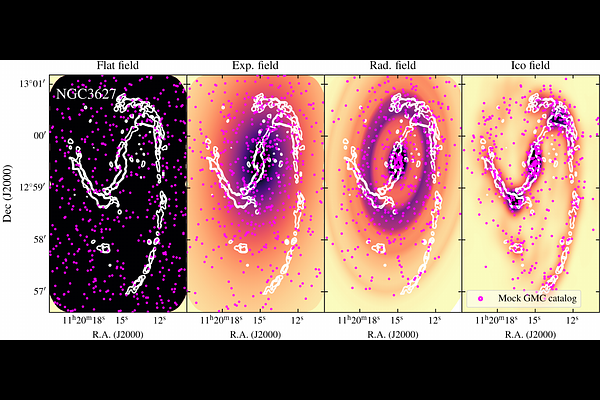
AbstractThe sub-kpc scale gas structure encodes key information of giant molecular cloud (GMC) formation. Therefore, we aim for a quantitative description of molecular gas structure across 150-1000 pc using a sample of 8984 GMCs from 40 galaxies observed by PHANGS-ALMA. We homogenize our data to a fixed resolution of 150 pc and mass sensitivity of 2.5 M$_{\odot}$ pc$^{-2}$ to remove observational bias. We then calculate nearest neighbour distances, neighbour number density, and two-point correlation functions for the catalogued GMCs. When analysing the two-point correlation function, we generate several control samples that reflect different null hypotheses on large spatial scales. We stack integrated intensity CO emission profiles around the position of catalogued GMCs to probe the gas distribution on scales between the resolution limit and the typical GMC-GMC spacing. Our measurements of cloud spacing and number of neighbours show that GMC clustering follows the large-scale gas distribution. Once we account for this contribution, the peak excess clustering in the two-point correlation function drops from 1+$ω$ of 2.3 to 1.3, with the power-law slope flattened from -0.25 to 0. We show that the stacked CO intensity profiles around CO peaks can be recovered by the "GMC size" measured by CPROPS, with an additional 20% of the flux in an extended component beyond 500 pc. We find that our stacked profiles can be fit with a double Gaussian function plus a constant offset. The broad Gaussian component accounts for 70% of the over-density power above the constant offset, and is stronger around massive and gravitationally bound GMCs. Our results indicate that galactic structure regulates the GMC distribution in galaxy disks, and the formation of massive, gravitationally bound GMCs is related to strong local gas clustering.