Radiation-ionization hydrodynamic simulations of AGN line-driven winds lead to transient shielding and BAL/UFO signatures

Radiation-ionization hydrodynamic simulations of AGN line-driven winds lead to transient shielding and BAL/UFO signatures
Nicolas Scepi, Christian Knigge, Amin Mosallanezhad, Knox S. Long, James H. Matthews, Stuart A. Sim, Austen Wallis
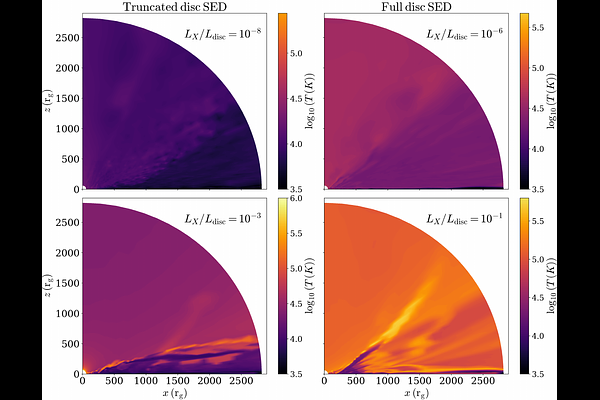
AbstractDisc winds from active galactic nuclei (AGN) can be launched by radiation pressure acting on spectral lines. However, launching a line-driven wind in the X-ray rich environment of AGN is challenging, as the wind easily gets over-ionized. Previous simulations suggested that X-ray self-shielding could enable line driving, though it remained unclear whether this relied on simplified treatments of radiation and ionization. Here, we revisit the X-ray shielding scenario using the first multi-frequency, multi-directional Monte-Carlo radiative photo-ionization hydrodynamical simulations of AGN line-driven winds. We find that sustaining a steady wind with mass-loss rates of $\approx20\%$ of the accretion rate requires an unrealistically weak X-ray flux ($α_{\rm OX}<-3$). For stronger X-ray emission ($-3<α_{\rm OX}<-1$), self-shielding is only transient, leading to episodic ejections with mass-loss rates approaching the accretion rate. Our steady winds naturally produce FeLoBAL, HiBAL, and broad emission line signatures, depending on the disc spectral energy distribution and the observer's inclination. At moderate X-ray luminosities ($α_{\rm OX}\sim-3$), transient winds can generate short-lived BAL and ultra-fast outflow (UFO) features. At the highest X-ray luminosities ($α_{\rm OX}\sim-1$), the winds are too ionized to form BALs, but still produce UFOs. These results imply that additional physics is required to explain BAL outflows at realistic X-ray levels and to drive winds strong enough for AGN feedback. Nonetheless, our simulations provide a new framework for interpreting the observed diversity of AGN outflow signatures with fully coupled radiation and dynamics.