Effect of dietary Chitosan supplementation on Intestinal Barrier Function and Growth Performance in weaned piglets challenged by Enterohemorrhagic haemolytic Escherichia coli

Effect of dietary Chitosan supplementation on Intestinal Barrier Function and Growth Performance in weaned piglets challenged by Enterohemorrhagic haemolytic Escherichia coli
Liu, J.; De Blassio, S.; Xie, K.; Li, X.; Luo, Y.; Zheng, P.; Mao, X.; Yan, H.; Wang, Q.; Good, L.; Pelligand, L.; He, J.
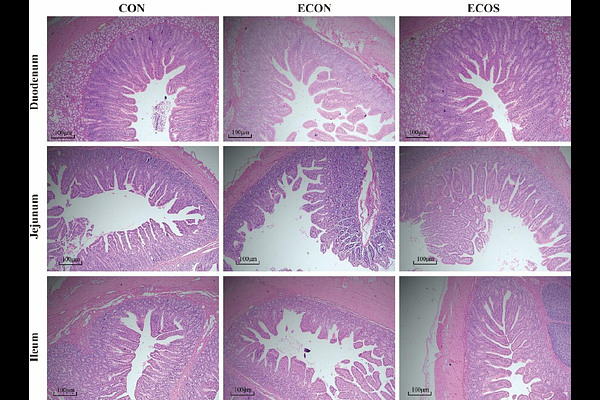
AbstractEnterohemorrhagic Escherichia coli O157:H7 (EHEC) is an important zoonotic pathogen that disrupts intestinal epithelial barrier integrity and induces excessive inflammatory responses, thereby leading to impaired growth performance and intestinal injury. EHEC is also an important cause Hemolytic Uremic Syndrome (HUS) in children and older adults. In pig production, chitosan is considered a promising alternative to antibiotics due to its bioadhesive and antimicrobial properties, but the effects and underlying mechanisms of chitosan (COS) under pathogenic challenge remain to be elucidated. One hundred and eight pigs were randomly divided into three treatments: an unchallenged control group (CON), an EHEC-challenged control group (ECON), and an EHEC-challenged group supplemented with 100 mg/kg COS (ECOS). Results show that EHEC challenge increased the feed conversion ratio (FCR), increased inflammatory cytokine levels, disrupted intestinal morphology, and downregulated tight junction and nutrient transporter gene expression (P<0.05). Dietary COS supplementation significantly improved average daily gain (ADG) and FCR during day 6-14 (P<0.05). Moreover, COS reduced fecal shedding of total E. coli (P = 0.085) and EHEC, attenuated systemic inflammation by decreasing serum TNF- and IL-6 levels, and enhanced humoral immunity as indicated by increased IgA and IgM concentrations (P<0.05). Importantly, COS alleviated EHEC-induced intestinal injury by restoring villus height and villus-to-crypt ratio, with enhanced mucosal digestive enzyme activities, and upregulated expression of tight junction proteins (ZO-1 and occludin) and nutrient transporters (SGLT-1 and PEPT1) (P<0.05). In conclusion, these findings indicate that dietary COS improves growth performance in EHEC-challenged weaned pigs, with enhanced intestinal barrier integrity and nutrient transport capacity.