TMS-Evoked Corticospinal Beta Oscillations in Humans Recorded from Muscles

TMS-Evoked Corticospinal Beta Oscillations in Humans Recorded from Muscles
Sarasquete, M.; Pascual Valdunciel, A.; Ciurluini, F.; De Havas, J.; Bestmann, S.; Farina, D.; Rocchi, L.; Hannah, R.; Ibanez, J.
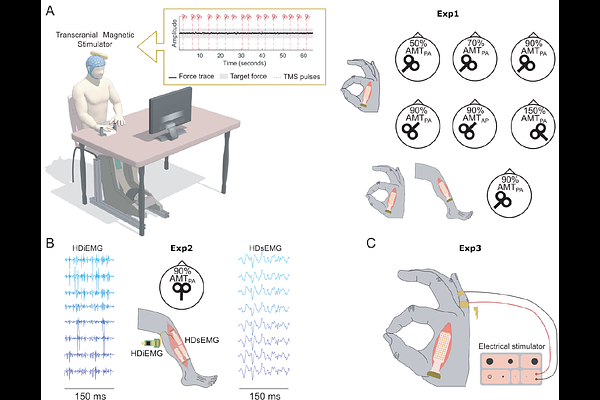
AbstractBackground: Transcranial magnetic stimulation (TMS) can entrain oscillatory brain activity, offering a promising approach to study motor-related neural oscillations such as beta rhythms. However, how TMS-induced corticospinal oscillations are generated, propagated, and related to endogenous activity remains unclear, partly due to limitations in brain recording techniques. Recording muscle activity provides an alternative and physiologically grounded window into corticospinal dynamics. Methods: We investigated whether subthreshold TMS over the motor cortex induces corticospinal oscillatory activity detectable in muscles, and whether these responses share neural generators with endogenous beta rhythms. Single-pulse subthreshold TMS was applied over the motor cortex in healthy participants while electromyography (EMG) was recorded from tonically active muscles. Stimulation intensity, coil orientation, and stimulation site were systematically varied. Concurrent electroencephalography (EEG) was used to assess cortical responses and corticomuscular transmission. In additional experiments, advanced EMG techniques were employed to track motor neuron pools and characterize how TMS-evoked oscillations are transmitted at the motor unit level. Results: TMS elicited a robust and short-latency increase in beta-band activity in the EMG. The analysis of the elicited muscle responses and the comparison of results across different TMS configurations indicate that the beta responses resulted from activation of inhibitory interneurons in the targeted primary motor cortex. Importantly, the characteristics of cortico-muscular coherence and beta projection to the muscles indicate that the elicited beta responses with TMS have same cortical sources as endogenously generated beta activity. Conclusions: These findings demonstrate that muscle recordings provide a sensitive and physiologically meaningful readout of TMS-induced corticospinal beta oscillations.